
360-degree automated characterization of AAVs: The safe solution for gene therapy
INTRODUCTION
Adeno-Associated Viruses (AAVs) are ideal gene therapy vectors since they are nonpathogenic, and their genome is small enough to be manipulated with standard recombinant DNA methodology. The characterisation of AAVs is key to ensure the safety and efficacy of the end product.
We present how the Fida 1 instrument is used for unbiased characterization of Adeno Associated Virus 2 (AAV2) particles. The AAV size and polydispersity as well as the presence of aggregates are determined in-solution, with no labelling requirements using only a few nL of sample. Titre can also be measured since the fluorescence intensity is proportional to thecon centration.
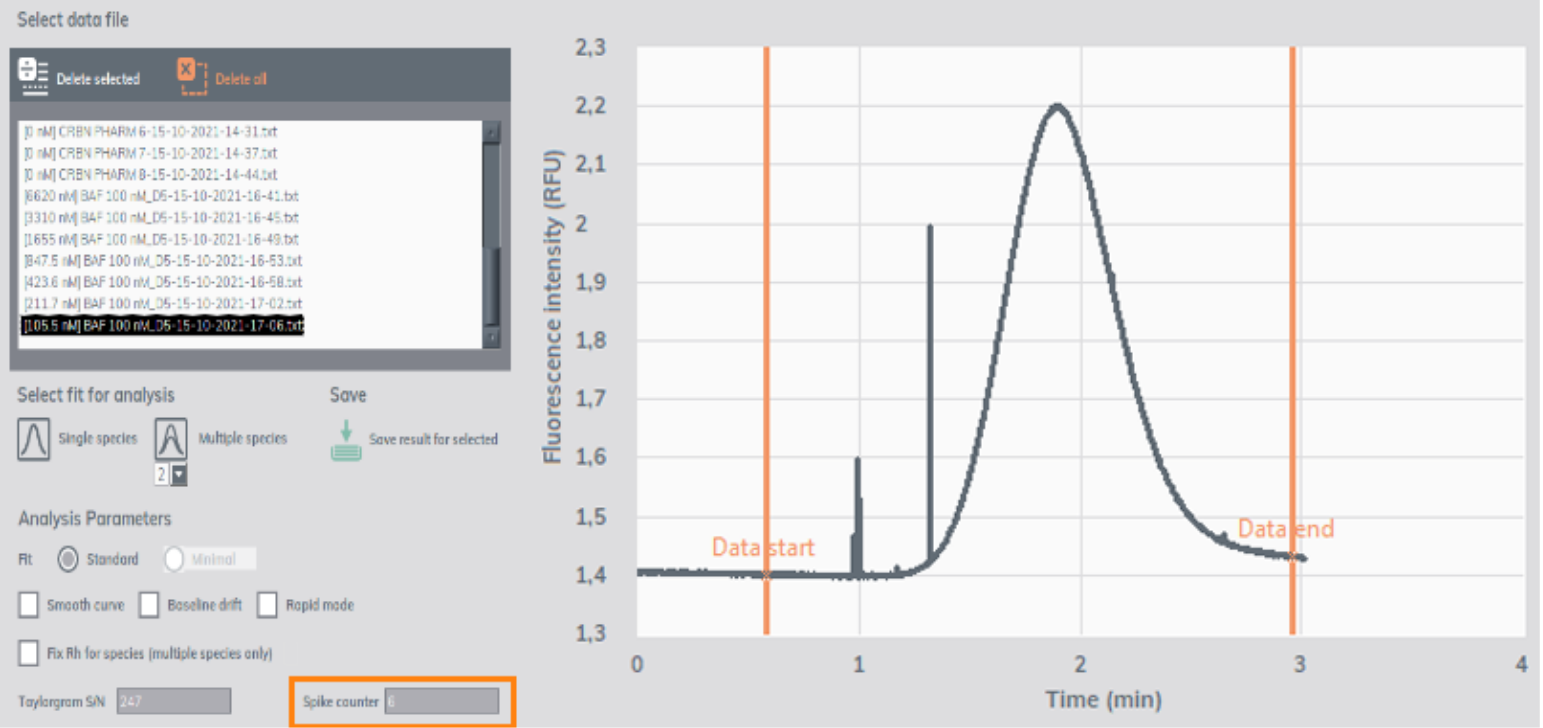
The application uses the Spike counter and Polydispersity Index (PDI) tools that are fully integrated in the Fidabio software for quantifying aggregates and Polydispersity Index, respectively. A few nanoliters of sample enable discrete aggregate counting, as each aggregate gives rise to a unique “spike” in the data. The Fidabio Spike counter is used to quantify the number of aggregates in the analysed sample (Figure 1).
The Fidabio PDI tool generates a polydispersity index similar to DLS technology, providing insights into the size distribution. Monodisperse samples exhibit a PDI approaching zero, whereas polydisperse samples have higher PDI values.
FIDA MEASURING PRINCIPLE
Flow Induced Dispersion Analysis is a capillary-based microfluidic method, exploiting that the flow rate in the centre of the capillary is faster than the one at the edges of the capillary. The resulting radial concentration gradients at the front and the tail of the dispersion results in diffusion of the intrinsically fluorescent AAV which enables a “first principle” biophysical measurement of size. The Fida 1 measurement of fluorescence and size can also be used for studying biomolecular stability, interactions, concentration etc. To learn more, visit fidabio.com.
MATERIAL & METHODS
Fida 1 instrument with 275 nm LED fluorescence detection was used for assay development (Fida Biosystems ApS) with Fida 1 standard capillary (i.d.: 75 µm, LT: 100 cm, Leff: 84 cm). PBS buffer, pH 7.4 was used as the working buffer. The experiment was conducted with a coated capillary (HS-coating reagent, Fidabio), using the automated coating protocol. The Fidabio “coated capillary method” was used to obtain the raw data. The AAV2 particles were acquired from a commercial vendor.
RESULTS
1st sample preparation
The hydrodynamic radius (Rh) of the particles was measured to be 8,5 nm (Dh=17 nm), and the Spike counter counted 830 aggregates in the 40 nL of sample used. This reveals a high degree of aggregation – 2,1 · 10 aggregates/ml (multiple spikes in Figure 2).
The polydispersity index gives information on the size distribution of the sample, and it was found to be 0,1.
2nd sample preparation
The Rh of the particles was measured to be 10,8 nm (Dh=21,6 nm), PDI=0,1 and Spike counter=46 in the 40 nL of sample used. This revealed a comparatively low degree of aggregation - 1 · 10 aggregate/ml.
.png)
.png)
CONCLUSION
Fida 1 provides an in-solution, label-free characterisation of AAVs generating multiple parameters from just a few nL of sample. Its ability to determine size, polydispersity index, aggregation and titre in a single run makes it ideal for formulation screening, as well as quality control of AAV preparations.