
Correlating Supramolecular Behaviour in Buffer and Plasma
INTRODUCTION
The present application note is based on work done in collaboration with Nikokaj Riis Christensen, PhD, et al. at the University of Copenhagen. A potential therapeutic molecule (arbitrarily named mX) was characterised for its properties in aqueous buffer as well as in human plasma. Due to its chemical structure, mX can self-assemble into higher order oligomeric structures, thus transitioning between monomer, oligomer and micelle structures. It was shown that Fida 1 provided reliable data for determining the transitions between various structures and good quality data for very low concentrations of mX, which was not possible on any other technology. In addition, FIDA experiments elucidated plasma behaviour of mX and showed it’s binding to HSA.
MATERIAL & METHODS
Fida 1 instrument with 480 nm LED fluorescence detection was used for assay development (Fida Biosystems ApS) with Fida standard capillary (i.d.: 75 µm, LT: 100 cm, Leff: 84 cm). PBS buffer at pH 7.5 was used. mX was fluorescently labelled. All samples were prepared in buffer and loaded onto the Fida 1 480 system, using either single glass vials or using a 96-well plate setup. The Fida 1 capillary was coated with HScoating, BSA coating (19 mg/ml), or using PolyOrnithine (1 mg/ml), otherwise an uncoated capillary was used. Samples were run in one of two ways; after flushing of the capillary with buffer, the capillary was filled with analyte (unlabelled) or buffer using 1500 mbar for 45 s, followed by a single injection of sample (indicator) using 50 mbar for 10 s. The sample was then flushed through using 400 mbar for 180 s.
RESULTS
In solution behavior of mX and comparison with SAXS
In solution, mX displays an interesting behaviour. Given its chemical structure, mX selfassembles into higher order oligomeric structures with a hydrophobic part being encapsulated by a hydrophilic part (micelle). Earlier investigations using SAXS found that mX assembles into micelles with a radius of gyration (Rg) of ~23Å (Figure 1A, 1B)
.png)
Plasma behavior of mX
As a potential therapeutic compound, mX requires subcutaneous or intravenous administration, and therefore the properties of mX in plasma are essential. Two outcomes were envisioned; mX would remain in a micelle assembly and thereby obtain plasma stability, or mX could alternatively be stabilised by binding to plasma proteins, such as Human serum albumin (HSA). We therefore tested; 1) the ability of mX to bind to HSA in solution and 2) the properties of mX in human plasma to validate either presence of micelles or HSA complexes in a more complex sample matrix. It was found that mX could indeed bind to HSA (Figure 3). Furthermore, the dominant species in plasma had an Rh of ~42-47 Å suggesting that mX associates with HSA rather than forming micelles in plasma.
.png)
Conclusion
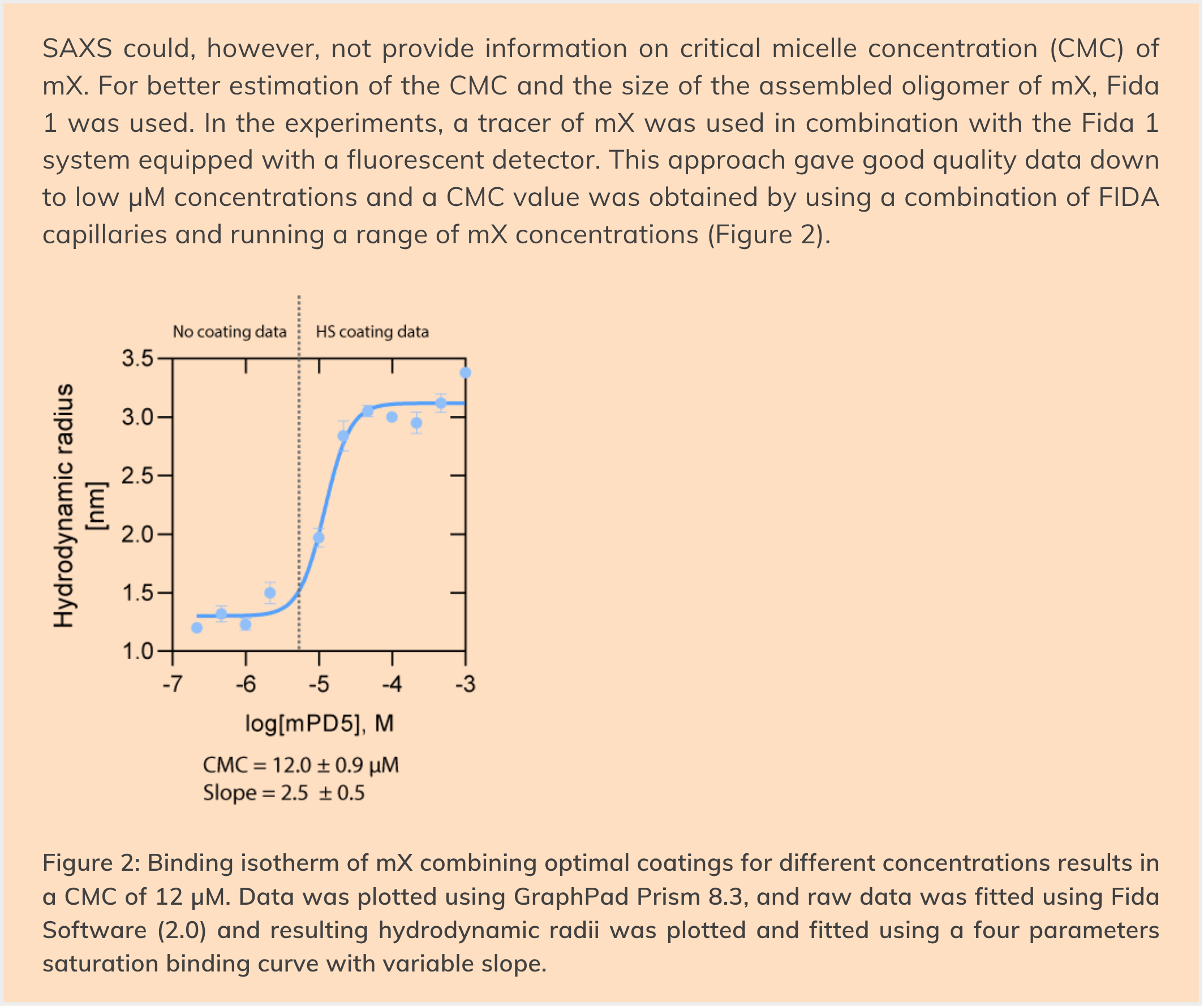
Fida 1 enables quick and easy validation of mX micelle formation with an Rh of ~30 Å, which is in good agreement with data obtained from SAXS. In addition, FIDA setup was able to provide a CMC value of 12 µM for mX, a critical information not obtained by any other techniques. It was also shown that in human plasma, mX could bind to HSA with a sub µM affinity. FIDA, thereby effectively elucidated mX behaviour in solution and in plasma, an important information for a potential therapeutic compound.