Keep learning!
Please fill out your details.

De Novo Protein Screening: Snake Venom to Cancer, Designing Binders Faster Than We Can Measure Them
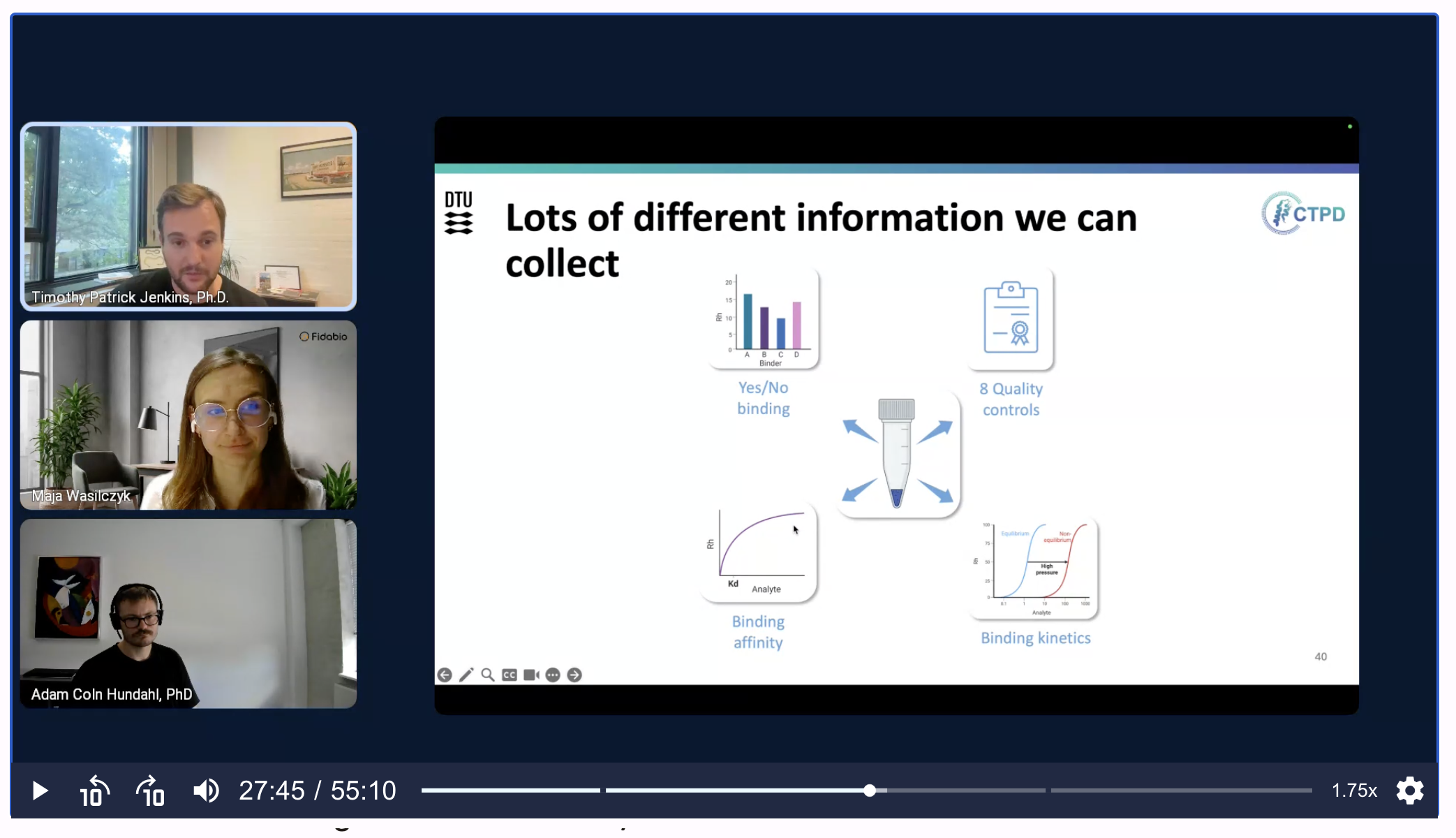
How do you keep up when AI can design protein binders faster than you can measure them? In this Fidabio webinar, Timothy Jenkins, associate professor and head of the Center for Translational Protein Design at the Technical University of Denmark (DTU), shows how his group designs de novo binders and nanobodies against targets from snake venom toxins to cancer, and where Flow Induced Dispersion Analysis (FIDA) fits as the fast measurement step. Modern protein-design tools now generate high-affinity mini-binders and nanobodies in weeks, some of which protected mice from lethal snake toxins in vivo, which shifts the bottleneck to wet-lab testing. Running on the automation-friendly Fida Evolve, FIDA provides rapid in-solution yes-or-no binding screens, target quality control (aggregation, oligomeric state and purity) and binding affinities from low sample volumes without purification, with values that closely matched BLI and SPR across the systems tested. Dr. Jenkins frames FIDA as the measurement step in a closed-loop, design-build-test workflow for binder discovery, developed alongside his startup Affinity AI and a Novo Nordisk and DTU partnership.

