Let us send you the file to your email.
You will receive the file on your email.

Designing Proteins with Rapid AI–Lab Iterations: using FIDA to quantify in-solution protein behavior.
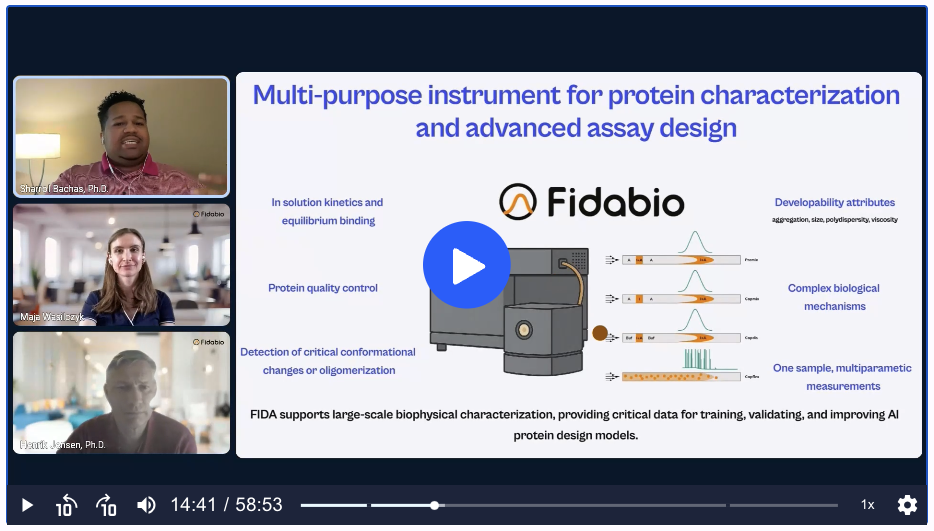
How do you know whether an AI-designed protein binder actually binds its target? In this Fidabio webinar, the AI protein-design company Onava shows how Flow Induced Dispersion Analysis (FIDA) measures binding and conformational change directly in solution within a closed-loop design–build–test workflow for de novo protein binders. In a single assay, FIDA's hydrodynamic-radius and Binding-Related Intensity Change (BRIC) readouts detected single-ångström conformational changes, confirmed binding where BLI and SPR failed, and measured mini-protein disruption of the TNF-α trimer and bispecific-driven force dissociation of IgE from its receptor. It is an example of using FIDA to generate in-solution binding and conformational data that trains AI models for protein design.

