Keep learning!
Please fill out your details.

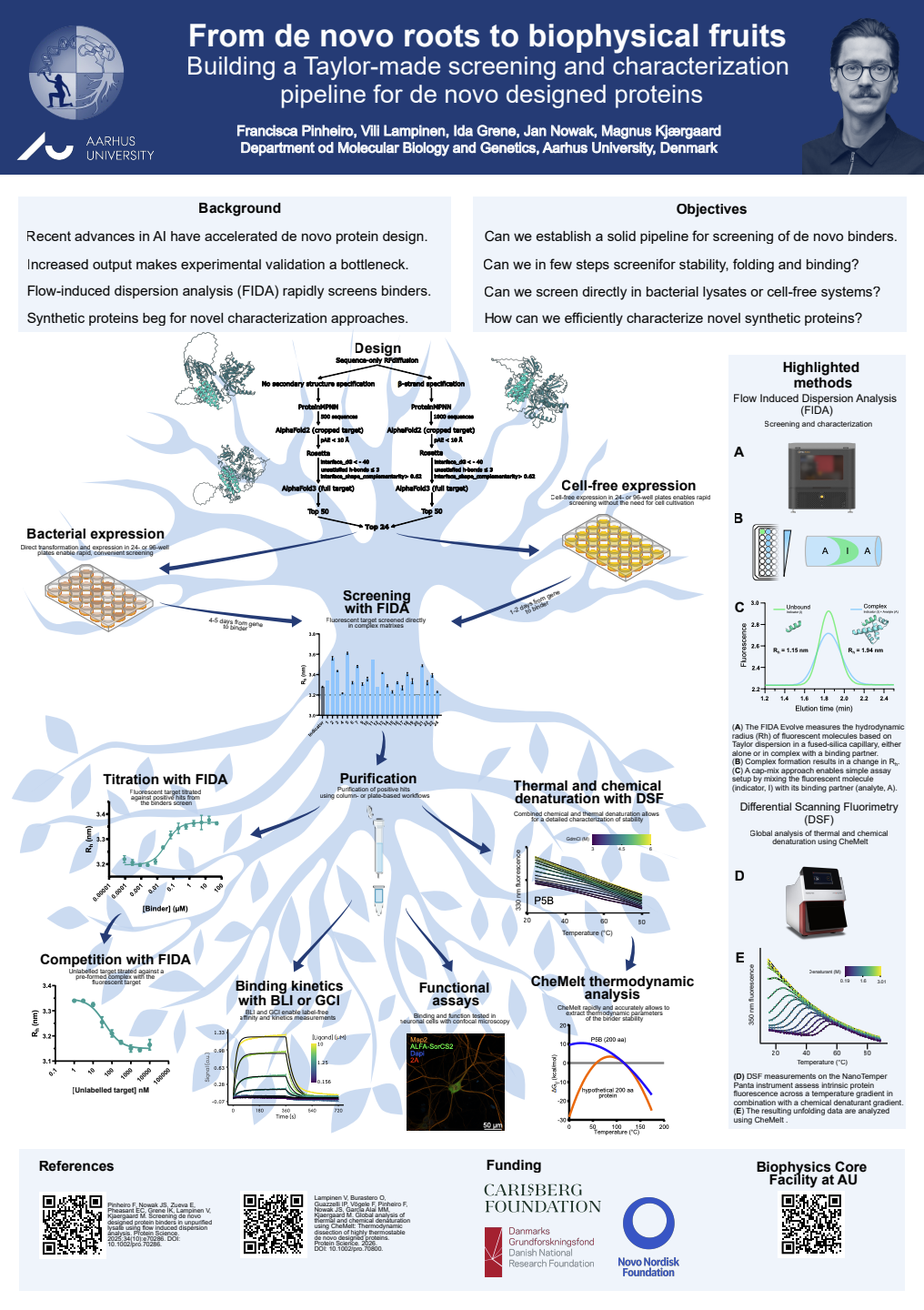
From de novo roots to biophysical fruits: building a Taylor-made screening and characterization pipeline for de novo designed proteins
This poster from the Department of Molecular Biology and Genetics at Aarhus University asks whether de novo designed proteins can be screened for binding, folding and stability in a few steps, directly in unpurified bacterial lysate or in cell-free expression mixtures, now that AI produces more designs than can be experimentally validated and purifying every candidate is the slowest step. Flow Induced Dispersion Analysis (FIDA), an efficient, in-solution method for protein characterisation, is what makes that possible: because nothing is immobilised and only the target carries a label, the fluorescent target can be measured in the crude matrix itself, and binding is read as an increase in hydrodynamic radius, in the worked example from 1.15 nm for the unbound target to 1.94 nm in complex. Taking purification out of the screening step is what puts the authors at 4 to 5 days from gene to binder with bacterial expression and 1 to 2 days with cell-free expression. Only the designs FIDA identifies go on to the rest of the pipeline: FIDA titration and competition with unlabelled target for affinity, label-free kinetics measurement, function tested in neuronal cells by confocal microscopy, and stability from combined thermal and chemical denaturation. It is an example of using FIDA as the enabling, in-solution screen for de novo designed proteins, triaging a designed set in a crude matrix so that only the candidates worth the effort are purified and characterised further.

