Keep learning!
Please fill out your details.

The importance of monomer conformation in amyloid formation of α-synuclein splice variants
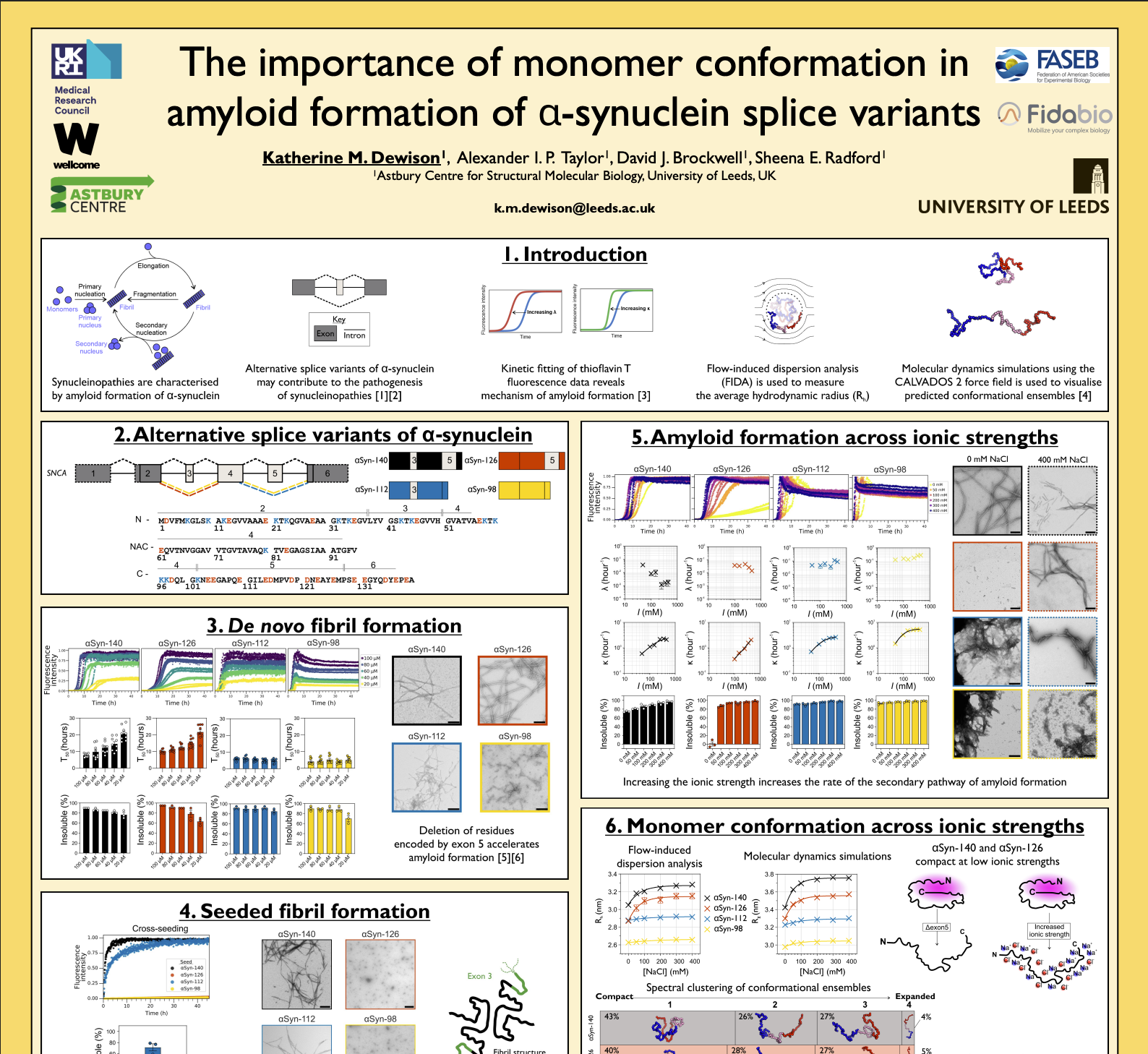
This poster characterises four α-synuclein isoforms, full-length αSyn and the splice variants αSynΔ3, αSynΔ5 and αSynΔ3Δ5, to show how differences in monomer conformation drive differences in amyloid formation relevant to Parkinson's disease and related synucleinopathies. Flow Induced Dispersion Analysis (FIDA), an efficient, in-solution method for protein characterisation, was used on a Fida 1 instrument to measure the hydrodynamic radius of each variant across a range of ionic strengths. Full-length αSyn and αSynΔ3 compacted substantially at low ionic strength, while αSynΔ5 and αSynΔ3Δ5 remained largely expanded, and this exon-5-dependent compaction correlated with slower secondary nucleation, linking the conformational state of the monomer directly to amyloid propensity. It is an example of using FIDA to detect subtle, ionic-strength-dependent conformational changes in an intrinsically disordered protein that govern its aggregation behaviour.
The peer-reviewed study behind this poster is published in the Journal of the American Chemical Society: Mapping the role of monomer conformation in the amyloid formation of α-synuclein splice variants.

