Dynamic range
From fragments to large biologics Dissociation constants from pM to mM. Kinetic processes from seconds to hours.
.jpg)
One FIDA run answers multiple biophysical questions, closing data gaps, and reducing time to insight.
Fida Evolve resolves molecular size, binding, and sample characteristics from one in-solution diffusion profile - replacing a stack of complementary assays with a single experiment.






Each FIDA run delivers three simultaneous, in-solution measurements and ten readouts in a single pass. Rather than separating functional study and characterization into sequential steps, you get both at once. Three independent readouts also allow for cross-validation within the same run, reducing ambiguity and accelerating time to insight.
Hydrodynamic radius measurement provides a direct, calibration-free assessment of molecular size in solution ...
Hydrodynamic radius measurement provides a direct, calibration-free assessment of molecular size in solution. By tracking hydrodynamic radius, FIDA reveals size changes due to binding, oligomerization, or aggregation. Because the readout is absolute, it offers a high level of confidence when monitoring subtle structural differences, conformational states, or purity. It is especially powerful in the era of AI, where absolute data is necessary for training analytical models.
.jpg)
FIDA LD is based on ratiometric fluorescence detection. by capturing shifts in the emission profile of the fluorescent tracer ...
FIDA LD is based on ratiometric fluorescence detection. by capturing shifts in the emission profile of the fluorescent tracer, it enables specific and quantitative analysis of interactions that would otherwise go unnoticed. This makes it ideal for fragment screening, small molecule profiling, and other applications where size-based detection is limited.
.jpg)
BRIC tracks changes in fluorescence intensity that occur upon binding. This direct signal allows for sensitive detection ...
Binding Related Intensity Change readout tracks changes in fluorescence intensity that occur upon binding. This direct signal allows for sensitive detection of binding events, including those with low affinity or occurring in complex or crude samples. It offers fast confirmation of interaction presence and can guide assay design or screening decisions.
All FIDA measurements occur in a laminar flow, in which molecules move and bind freely, as they would in biology. Since there is no surface to bind to, there are no surface-related issues, and physiological relevance is increased. For FIDA complex biological matrices are the starting point, not an obstacle.
New modalities are challenging to purify or immobilize without altering their structure, function, or binding behavior. Purification can strip away co-factors, disrupt assemblies, or select for only a subset of the population. Being able to work in solution, in unpurified samples, means you measure the target as it actually exists, in its native molecular context. For many new modalities, this is the best way to obtain biologically meaningful data.
.jpg)

Whole blood-derived matrices.

Direct from lysis.

Low-abundance patient samples.

Monitor production samples.
.jpg)

Structure and function are inseparable. Save sample material, time and preserve the biological context thanks to embedded sample characterization in your binding studies.
Fida Evolve allows for easy raw metadata export, and connects with supporting closed feedback loops between generative modelling, automated in vitro assays and in silico screening. Its rest API software with built-in SiLA driver enables lab automation, while connecting to existing LIMS and digital lab infrastructure.
the hydrodynamic radius readout is absolute and calibration-free, offering high confidence across users and conditions without needing to recalibrate or normalize between runs.
Compress weeks of biophysics into a few routine runs. FIDA Evolve resolves molecular size, binding, and sample characteristics from one in-solution diffusion profile - replacing a stack of complementary assays with a single experiment
From fragments to large biologics Dissociation constants from pM to mM. Kinetic processes from seconds to hours.
.svg)
Nanolitre volumes. Unpurified samples. Absolute data. Fida Evolve works directly with complex, heterogeneous samples at nanolitre scale. Assay setup is fast, calibration-free, and ready for the most challenging targets.
Cross-validation built into every run 8–10 characterization parameters — viscosity, aggregation, homogeneity — generated automatically alongside binding data. You know whether a result is real before the next experiment begins.
Multiple questions answered in one assay.Binding affinity, kinetics, aggregation, oligomerisation, and conformational changes — resolved from a single in-solution diffusion profile. Data gaps closed in the same run that raises them.
Routines that used to take days, finished in minutes. Fewer experiments, faster time to insight, measurable impact on lab economics. High data yield per sample means every run counts.

One instrument, the coverage of many. Binding affinity, binding kinetics, aggregation, oligomerisation, conformational changes — and more. FIDA Evolve replaces a stack of complementary technologies with a single, unified workflow.
Parameters per run
Affinity range
Sample volume
Workflows replaced with one
Result: Faster, easier, yet more reliable biophysical characterization with minimal sample consumption, and no need for purification.
Replace a stack of complementary assays with a single FIDA experiment.
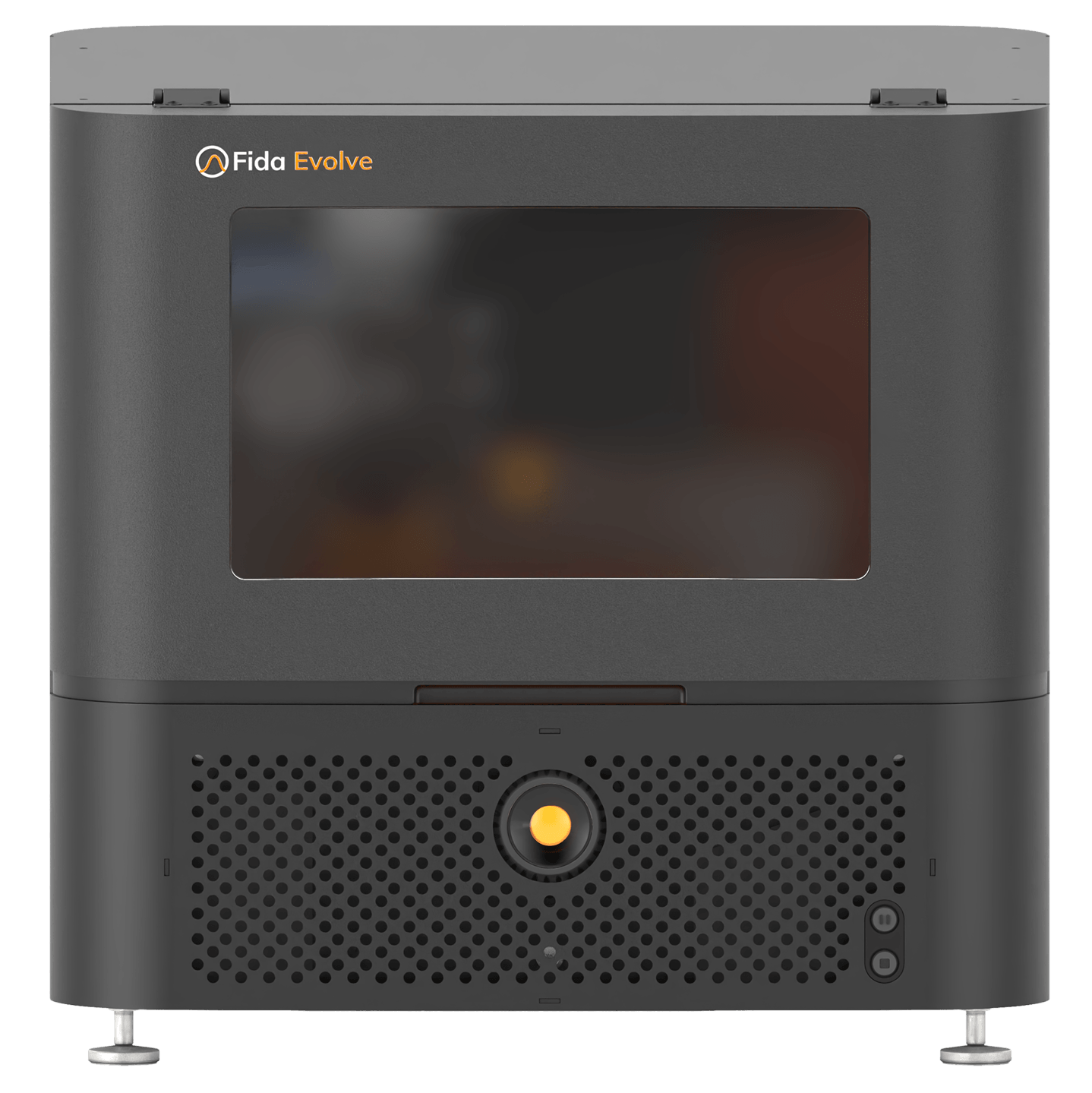
Mid-Run Sequence Editing: pause and modify assay sequences during a live run for flexible, exploratory workflows.

Autosampler temperature control
5°- 95°C (41°-203°F)
Capillary temperature control
15°- 55°C (59°-131°F)
Size accuracy
1% size change
Click-on consumables: tool-free, calibration-free swapping of detectors and capillaries, combined with a pre-calibrated, self-regulating pressure system, reduces training burden and downtime while eliminating manual calibration.
Detection based on fluorescence (labelled or intrinsic), with multiple wavelengths available: UV (label free), 480, 640
Kinetics: sec-hrs
Dissociation constant: pM - mM
Covering weak binders, fragments, and strong biologics alike.
Sample capacity per run:
Up to 2 x 96 samples.
Low sample volumes (nL–µL)
Wide concentration range.
.png)
.png)
Answers multiple biophysical questions with one run, closes data gaps, and reduce time to insight.
FIDA (Flow-Induced Dispersion Analysis) can be applied to a wide range of sample types because it measures molecules directly in solution, without requiring immobilization or separation. This makes it particularly well suited for working with complex and native systems.
FIDA is especially valuable for analyzing complex, native or unpurified samples. It can measure targets directly in matrices such as serum, plasma, cerebrospinal fluid, cell lysates, or fermentation media. This allows experiments to be performed in environments that are closer to native conditions, avoiding purification steps that may alter molecular behavior or introduce bias.
It also performs well with heterogeneous or partially purified samples. By measuring absolute molecular size (hydrodynamic radius), FIDA can distinguish between different populations in solution, such as bound and unbound species or different oligomeric states. This makes it useful for assessing sample quality, polydispersity, and interaction specificity in real-world samples.
In addition, FIDA is robust across a wide range of buffer and formulation conditions, including high salt, detergents, and crowding agents. Combined with its low sample consumption, this supports applications such as formulation screening, stability studies, and work with limited or difficult-to-obtain material. For purified samples, FIDA is commonly used with proteins, peptides, antibodies, small molecules, and nucleic acids. In these well-defined systems, it provides precise and quantitative readouts such as hydrodynamic radius, binding affinity, and interaction profiles, enabling detailed characterization of molecular interactions.
Autosampler temperature control: 5°- 95°C (41°-203°F)
Capillary temperature control: 15°- 55°C (59°-131°F)
Kinetic processes from seconds to hours.
The system measures dissociation constants (Kᴅ) from picomolar (pM) to millimolar (mM).
Fida Evolve introduces an extra Kd determination method, which is optimized for high-throughput workflows and early-stage screening. It can be used before running a full titration.
Instead of measurements at discrete concentrations, a Taylor-dispersion–induced concentration gradient inside the capillary exposes the target to a continuous titration of analytes, from which the binding affinity is derived. The result is a fast, low-resource method that retains in-solution accuracy and requires no surface immobilization, making it ideal for prioritising hits without compromising data quality.
Read more in this publication. Or watch this webinar.
FIDA delivers 3 simultaneous measurements – for increased precision, reproducibility and extended workflow capacities.
Absolute size (hydrodynamic radius) measurement provides a direct, calibration-free assessment of molecular size in solution. By tracking hydrodynamic radius, FIDA reveals size changes due to binding, oligomerization, or aggregation. Because the readout is absolute, it offers a high level of confidence when monitoring subtle structural differences, conformational states, or purity. It is especially powerful in the era of AI, where absolute data is necessary for training analytical models.
Lambda Dynamics (Ratiometric fluorescence detection) readout: by capturing shifts in the emission profile of the fluorescent tracer, it enables specific and quantitative analysis of interactions that would otherwise go unnoticed. This makes it ideal for fragment screening, small molecule profiling, and other applications where size-based detection is limited.
Binding Related Intensity Change readout tracks changes in fluorescence intensity that occur upon binding. This direct signal allows for sensitive detection of binding events, including those with low affinity or occurring in complex or crude samples. It offers fast confirmation of interaction presence and can guide assay design or screening decisions.
Thank you for your interest in FIDA Technology. Fill in the form to the right to schedule a discovery call.
*You will be contacted within 3 business days.