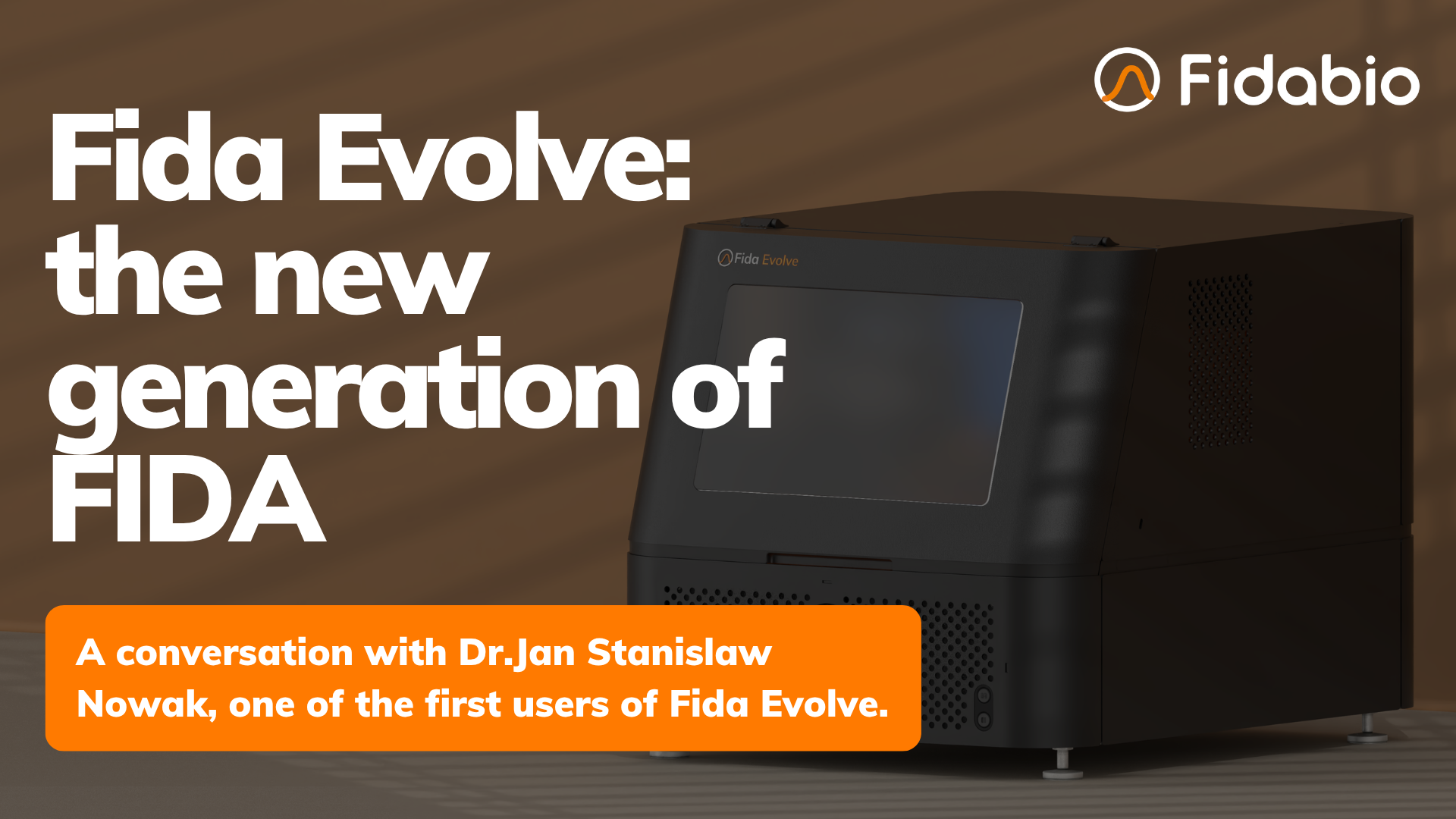
The new Fida Evolve: what is it, how does it differ, and what do early users think?
What is Fida Evolve, and how is Fidabio’s newest instrument different from the Fida 1 and Fida Neo that came before it? In short: Fida Evolve runs the same Flow Induced Dispersion Analysis (FIDA) that users already know, the same in-solution measurement of size and binding, the same rich readouts, but the hardware has been rebuilt from the ground up to make the technique quieter, faster and much easier to run day to day.
Hasse Hedeby, a co-founder of Fidabio, has detailed what changed in the instrument, while Jan Nowak, Ph.D., a staff scientist at Aarhus University who beta-tested Fida Evolve and then bought one for his core facility, has described what it is like to work with it day to day. Here are the practical points.
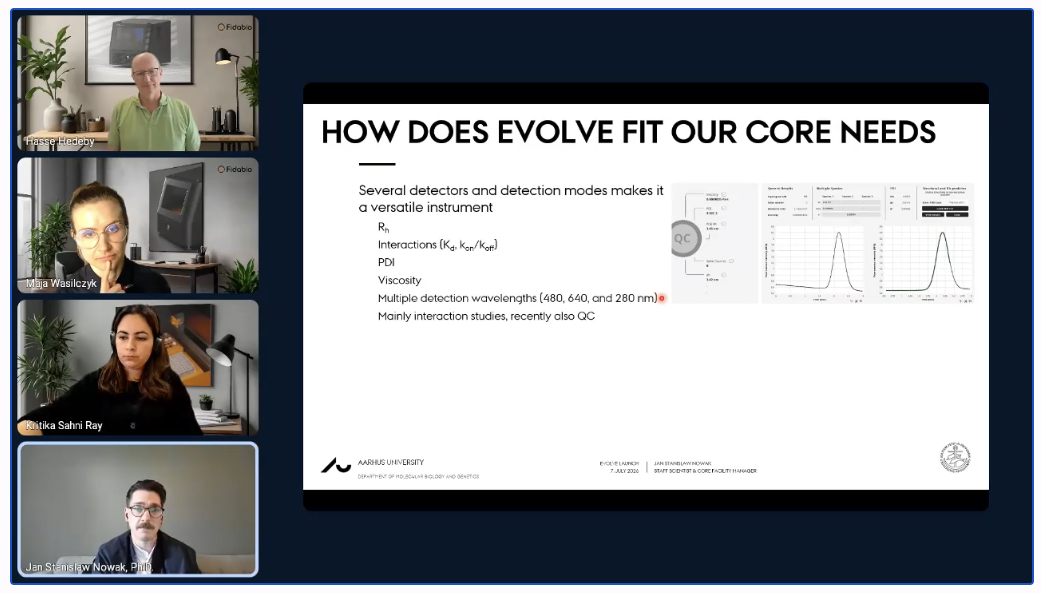
You can also watch the full webinar recording.
First, what is FIDA, and what is Fida Evolve?
FIDA stands for Flow Induced Dispersion Analysis. A fluorescently detected sample is pushed through a capillary under gentle, laminar flow; because the centre of the flow moves faster than the edges, the sample spreads into a dispersed profile whose shape depends on how fast the molecules diffuse sideways, which in turn depends on their size. From the width of that profile, physics does the rest: the Taylor-Aris relationship and the Stokes-Einstein equation convert the peak shape directly into a hydrodynamic radius in nanometres, with no calibration required. Smaller or free molecules disperse less; larger or bound ones disperse more.
Fida Evolve is the newest instrument in that family, following the Fida 1 and the Fida Neo. As Hasse put it, FIDA usage has grown sharply in recent years, and Evolve was built to take a powerful technique and make it more routine-friendly and seamless, without giving up any of the depth that experienced users rely on.
How does Fida Evolve differ from Fida 1 and Fida Neo?
The concepts are familiar: a sample deck that takes 96-well plates or vials, a capillary tucked inside a cartridge, and a detector mounted in the instrument. What changed is almost everything about how you interact with those parts.
“I was blown away by how easy it was to change from one detector to another, and to change the capillary itself.” Jan Nowak said.
- Click-in detectors. Three are available — 480 nm (blue), 640 nm (red) and a 280 nm UV detector for label-free work — and swapping one is now loosen a screw, lift out, drop in, tighten, rather than threading fibre optics.
- A click-in capillary cartridge. No more mounting or aligning a bare capillary; the cartridge has tight pressure and temperature control and a built-in waste reservoir.
- Samples from as little as 2 µL.
- Built for automation. The deck is presented outward for a robotic arm, and with API software and a standard automation driver it plugs into automated workflows.
Download the product brochure for more.
See Fida Instrument comparison.
What can it do that felt harder before, and what stays the same?
The measurement itself is unchanged, and that is the point. Every FIDA run still reports far more than one number: the hydrodynamic radius (size and binding), a change in fluorescence intensity on binding, and a Lambda Dynamics readout that compares two parts of the emission spectrum to catch red- or blue-shifts, all from a single recording. The same data also flags sample quality: insoluble aggregates show up as sharp spikes, sticky material as tailing, and the method reports viscosity, polydispersity and even how much fluorescent label is still attached versus free. Affinities can be followed from picomolar to millimolar, kinetics measured at the same time, and crude matrices such as plasma, serum or cell lysate need no purification first.
What Evolve adds is on top of that, not in place of it. The instrument software gained useful conveniences, it can now predict how much sample and wash buffer each vial will need, so users can prepare properly for long runs, and a new pause-and-play button lets you stop a running sequence, fix a method or a mistyped concentration, and resume from where it left off. Nothing was removed from the Fida Neo software, the analysis software is the same, and the quality and extent of the data you collect is the same as on the earlier instrument.
What does a beta tester actually think?
Jan Nowak runs a core facility at Aarhus University in Denmark and has used FIDA since his master’s, on one of the earliest commercial FIDA systems ever sold. His facility is well equipped, microscale thermophoresis, ITC, BLI, grating-coupled interferometry, mass photometry and DLS, so a new instrument has to earn its place. For him, that comes down to versatility, ease of use, good software and responsive support, because his goal is to get users independent quickly rather than standing over the machine.
In everyday use, that ease of use is what stood out. Swapping detectors and the capillary cartridge became a simple click-in rather than a fiddly, glasses-on task; because the capillary now moves visibly, users can see what the instrument is doing and catch a misconfigured run early; and it runs noticeably quieter.
“I could use it with my eyes closed, and especially with the Fida Evolve it’s become very user-friendly and way easier to explain,”
“For a core facility, from my slightly biased point of view, it’s just a must-have,” Jan Nowak said.
What's the impact of Fida Evolve?
Two things stood out for Jan. First, the extra detectors opened up work he had rarely done on a 480 nm-only setup: the 640 nm detector gave clean, low-background protein profiles, and the 280 nm channel made everyday protein quality control straightforward.
“I’ve been more and more happy recently to run protein samples on FIDA before doing anything else, just to see the condition of the sample before I bring it to another technique that takes a lot of time,” Jan Nowak said.
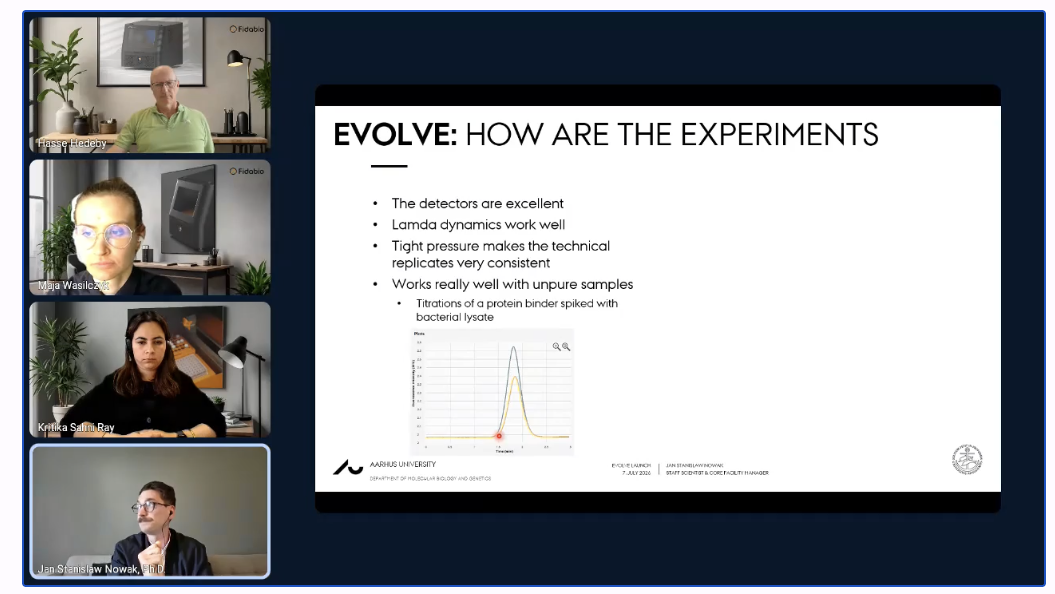
Second, Lambda Dynamics proved its worth where size barely changes but the label’s chemical environment does, such as small-molecule or peptide binding. In one protein-protein titration, the hydrodynamic radius and the Lambda Dynamics readout returned essentially the same dissociation constant, which he found convincing. He also stress-tested the instrument by running a labelled binder in clean buffer and then in the same buffer spiked with bacterial lysate, metabolites, DNA and all, and still saw a flat baseline with no extra intensity, the interaction measurable in the crude sample.
“The detectors just do an excellent job. I was mostly blown away by the 640 nm detector, because it gives such a good signal with almost no background, and you see a very nice, clean profile of a protein,” Jan Nowak said.
The takeaway
Fida Evolve is not a new technique, it is the same FIDA, made more approachable. The rebuilt hardware and software lower the barrier to routine use and make automation straightforward, while the underlying measurement, the parameters and the analysis stay exactly as capable as before. For a lab that wants faster insight with less friction, that combination is the story.
Curious whether Fida Evolve fits your work? Explore the FIDA technology, see the Fida Evolve, or browse the peer-reviewed literature. You can also watch the full webinar with Hasse Hedeby and Jan Nowak.
.png)