
What is state-centric biophysics, and why molecular states matter
For decades, biophysics asked a fairly simple question of a molecule: does it bind, and how tightly? A 2026 review in Biophysical Reviews by Dores-Silva et al., The rise of state-centric biophysics, argues that the field is outgrowing that question, proposing instead that biomolecules are best understood as dynamic ensembles of interconverting states, in which what a molecule does often depends less on whether a ligand binds than on which state it stabilises.
What follows is our own summary of that independent review. Its authors are researchers unaffiliated with Fidabio; we are highlighting published work we found thought-provoking, not claiming any part in it, and any interpretation here is our reading of their paper. Our own perspective is kept separate, at the end.
From molecular properties to molecular states
Dores-Silva et al. (2026) call their framework state-centric biophysics. Rather than treating each measurement as an isolated result, they suggest reading measurements as complementary views of a single underlying molecular-state landscape. The change in the question is subtle but large: where classical biophysics largely asked whether molecules interact, a state-centric view asks which molecular state is responsible for an observed outcome, and how a perturbation redistributes the population across the states a molecule can access.
In their account, several properties help to map that landscape together: affinity, kinetics, thermodynamics, stability, structural dynamics, hydrodynamics (molecular size, shape and diffusion), ligand occupancy and assembly state. The argument is that no single property is decisive on its own; read together, they describe which states a molecule occupies and how binding, modification or a change in conditions moves it between them.
The idea of information density
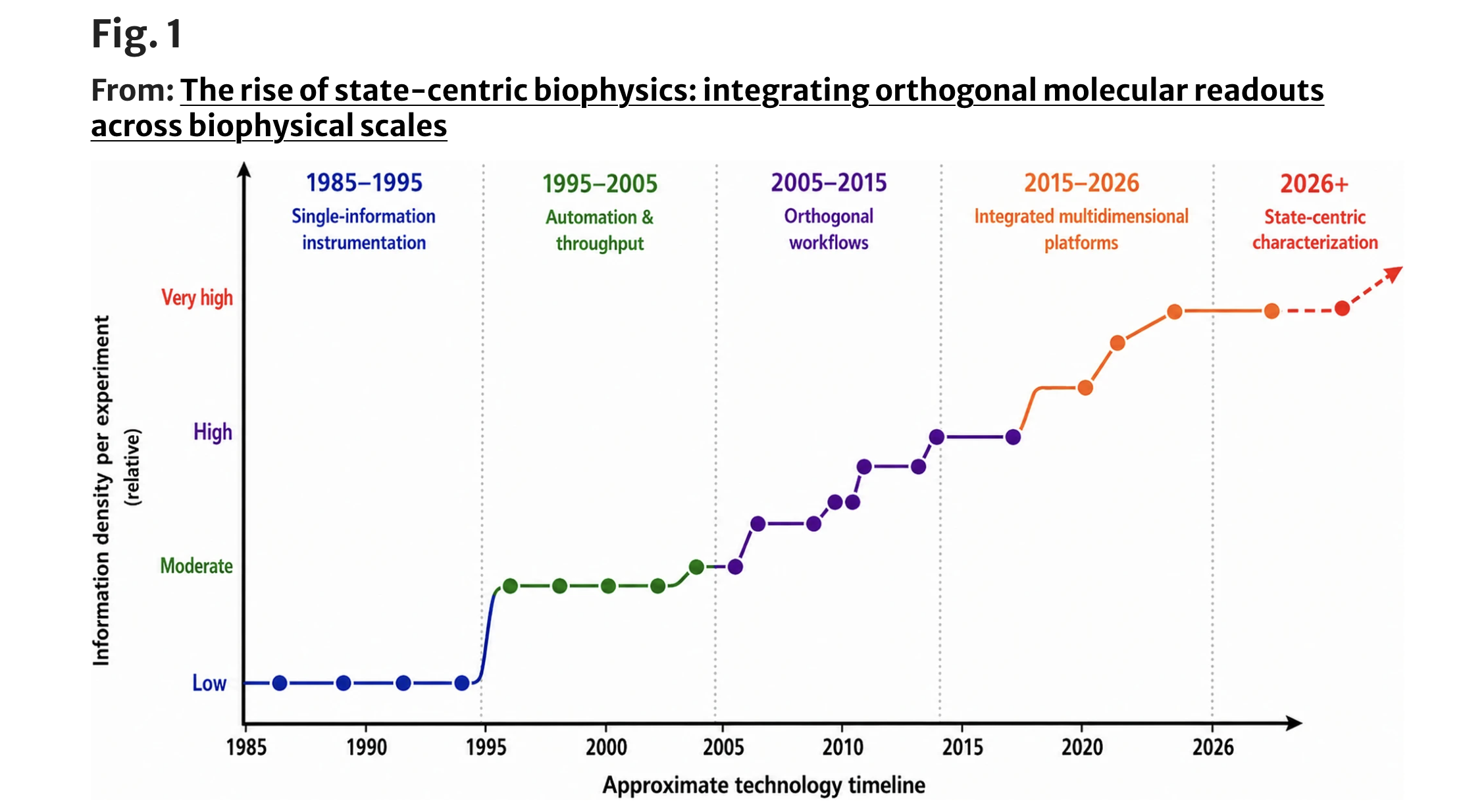
A central theme of the review is what the authors term information density: broadly, how much complementary molecular information can be drawn from a single experiment, platform, sample or tightly connected workflow. They present it not as a formal metric but as a way to describe how much modern biophysics can now connect within one interpretive frame. Its rise, they suggest, has been driven by three developments: more sensitive instrumentation, able to detect weak, transient and heterogeneous interactions; orthogonal workflows that combine independent techniques so that results converge; and multidimensional platforms that return several molecular readouts from one experimental context. Among the examples the authors cite in that last category are flow-induced dispersion analysis (FIDA), mass photometry, microscale thermophoresis and electro-switchable biosensors, methods they group together for their ability to report multiple facets of a molecule from a single experiment. In their telling, newer methods have tended to add to the older ones rather than replace them.
When binding alone does not explain function
Much of the review's argument rests on worked examples in which ligand occupancy alone does not predict what a molecule does:
- Targeted protein degradation, where a degrader may bind its target well yet fail if it stabilises a conformation that cannot recruit the degradation machinery, so efficiency depends on the state of the complex rather than on affinity.
- Molecular glues, which act by stabilising an otherwise transient protein-protein interface, so the state a compound populates can predict efficacy better than a binding constant.
- The HSP90 chaperone cycle, where inhibitors act by disrupting conformational transitions, making the relevant question which state is stabilised or destabilised, and when, rather than the affinity for the resting protein.
- State-selective KRAS G12C inhibition, where drugs engage a particular nucleotide-bound state of the target and not the active one, so selectivity follows from state compatibility rather than from affinity alone.
Across these cases, the authors argue, biological activity often turns on molecular-state properties that extend beyond simple ligand occupancy.
The central challenge, as the authors frame it
The review closes by reframing the discipline's task. In the authors' account, the emphasis is moving from measuring individual molecular properties toward identifying the molecular states that govern mechanism, efficacy, selectivity and therapeutic response, and information density becomes useful only when complementary measurements converge on a shared picture of which states drive an outcome, rather than accumulating isolated parameters.
Reference. Dores-Silva, P. R., Pascarella, T. W., Newman, J. M., & Borges, J. C. (2026). The rise of state-centric biophysics: integrating orthogonal molecular readouts across biophysical scales. Biophysical Reviews. https://doi.org/10.1007/s12551-026-01452-9
A note from Fidabio
Everything above is our summary of an independent review. The paragraph below is our own perspective, and is not part of, or endorsed by, the cited work.
Notably for us, the authors place Flow Induced Dispersion Analysis (FIDA) among the multidimensional platforms they see driving this shift, listing it alongside mass photometry, microscale thermophoresis and electro-switchable biosensors as methods that report several facets of a molecule from one experiment. That is close to how we think about our own technology. We design FIDA around three aims: high data yield, many connected readouts (size, affinity, stability, assembly and more) from one in-solution run; a low sample-to-data ratio, as little as tens of nanolitres of material per data point; and fast time to data, an answer in minutes. Our goal is that one small sample gives a fuller read on which state a molecule occupies, not just whether it binds.
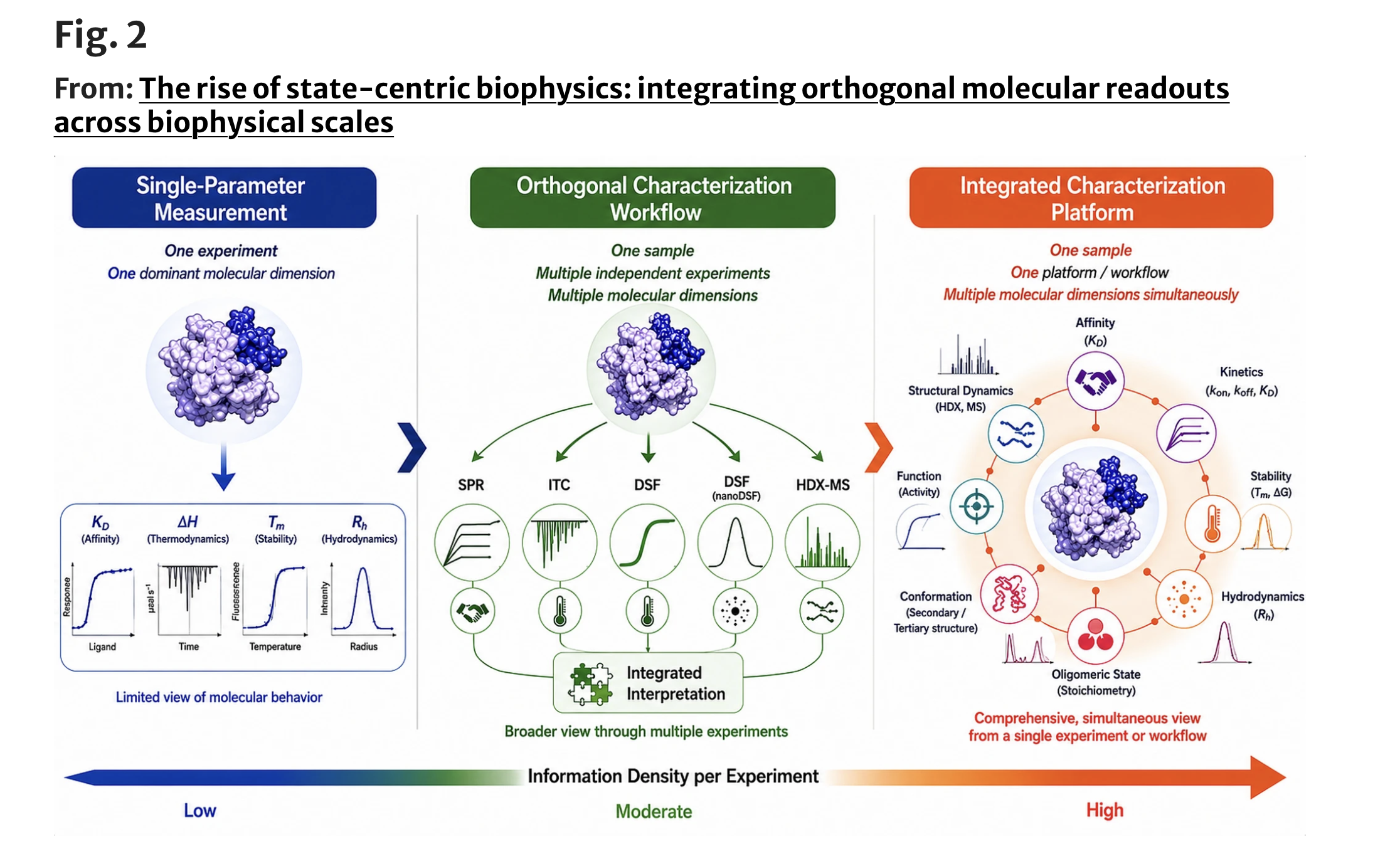
On the review's own maps of this shift, that places FIDA toward the high-information-density end. In Figure 1, it belongs to the trajectory the authors track toward the highest information density per experiment, it sits with the integrated platform on the right, where one sample yields several molecular dimensions at once — affinity, kinetics, stability, hydrodynamics and oligomeric state — rather than the single-parameter measurement on the left. Explore all of the simultaneous FIDA readouts.
Curious how FIDA measures size, binding, stability and assembly in solution? Explore the FIDA technology and the Fida instrument, or browse the peer-reviewed literature.