Keep learning!
Please fill out your details.

Engineering Galectin-1 Valency to Promote Glycan-Dependent MSC-EV Association
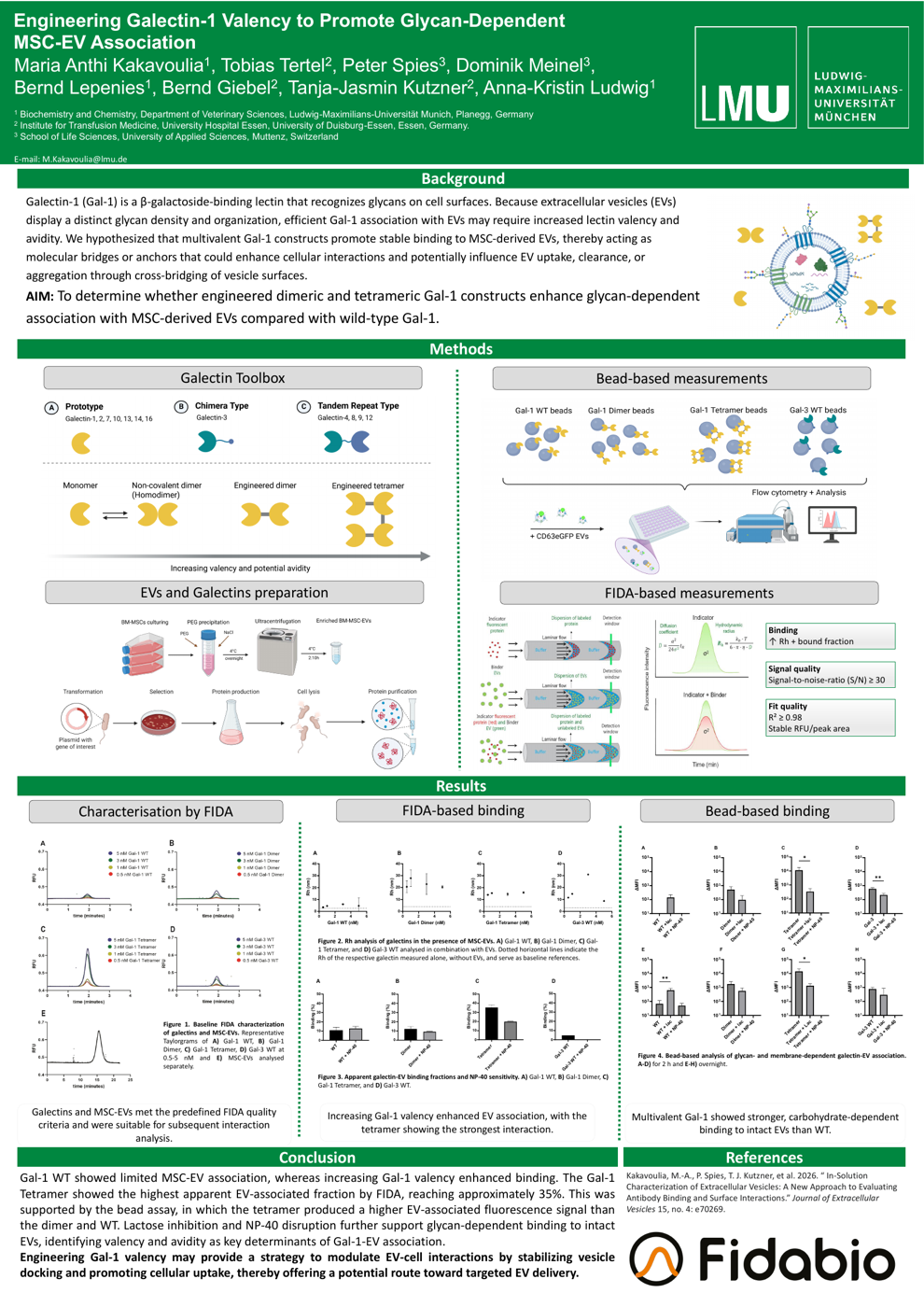
This poster from Ludwig-Maximilians-Universität Munich, the University of Duisburg-Essen and the University of Applied Sciences Muttenz asks whether engineering galectin-1 into dimeric and tetrameric forms strengthens its association with extracellular vesicles from mesenchymal stem cells (MSC-EVs). Flow Induced Dispersion Analysis (FIDA), an efficient, in-solution method for protein characterisation, carried the study: first to characterise each galectin construct and the vesicles themselves against defined signal and fit quality criteria, then to measure binding directly in free solution, read as the increase in hydrodynamic radius of the lectin and the fraction of it associated with vesicles. Because nothing is immobilised, the vesicles stayed intact and in suspension, so adding lactose or disrupting the membrane with detergent could be used within the same assay to show that the association was glycan-dependent and required intact vesicles. Increasing valency increased association, with the tetramer binding most strongly, and a bead-based assay supported the FIDA result. It is an example of using FIDA to measure lectin binding to extracellular vesicles in solution and to test what that binding depends on.
From the same group, the earlier poster FIDA: a novel technique for determination of protein binding on extracellular vesicles applied the method to galectins and antibodies on MSC and serum EVs.

