.png)
From snakebite to cancer: designing protein binders faster than we can measure them
What happens when you can design a protein binder faster than you can measure whether it works? That bottleneck is where modern protein design has arrived, and it was the theme of a Fidabio webinar with Professor Timothy Jenkins, associate professor and head of the Center for Translational Protein Design at the Technical University of Denmark (DTU), and founder of the startup Affinity AI. His talk ran from snake venom to cancer, and showed where Flow Induced Dispersion Analysis (FIDA) fits as the fast measurement step.
A century-old therapy for a neglected disease
Dr. Timothy Jenkins opened with the scale of the problem. Snakebite envenoming remains one of the most severely neglected tropical diseases, and the figures he presented were already grim: around 150,000 deaths a year and roughly three times that number left permanently disabled. Recent work, he told us, suggests the real toll is closer to double that. The burden falls overwhelmingly on the global south.
As Dr. Jenkins described it, the only specific treatment is antivenom, still produced much as it was a century ago: milk a snake, immunise a horse over the course of a year, take its blood, purify the plasma, inject it into a person. Most of the antibodies delivered are not directed against snake toxins at all, but against whatever the horse's immune system has met in its life. The therapeutic content is low, so large volumes of foreign protein have to be injected, and some patients die of the treatment rather than the venom. He would still be grateful to receive it if he were bitten, he said, but there are better ways to do this. And the engineering problem is not one target, or five: it is roughly 2,000 snake venom toxins worldwide, ideally neutralised by as few products as possible.
Designing the needle instead of searching for it
Dr. Timothy Jenkins then turned to the alternative: stop searching and start designing. Working with David Baker's lab, his group applied de novo protein design to three-finger toxins, the neurotoxins that bind the nicotinic acetylcholine receptor and cause paralysis, and the cytotoxins that destroy tissue locally.
The designed mini-binders came together in a matter of weeks. They were monomeric, well-behaved and high-affinity, and because the software was told where to bind, they engaged the functional site rather than an irrelevant patch on the back of the toxin. One survived above 100 °C. Most importantly, as Dr. Jenkins emphasised, they were not only test-tube molecules: they protected mice against lethal toxin doses, the first demonstration that AI-designed binders work in living systems. The project was highlighted by Professor Baker around his Nobel Prize, which, as Dr. Jenkins noted, did more for snakebite funding than years of advocacy had managed.
The same approach, applied to cancer
To show that the method generalises, Dr. Timothy Jenkins turned to a project run with Sine Reker Hadrup's group at DTU Health Tech, in the setting of CAR-T cell therapy. The trick in immunotherapy, he explained, is giving the immune cell a reliable way to tell a cancer cell from a healthy one, another needle-in-a-haystack problem and a good candidate for design rather than discovery.
The team designed mini-binders recognising a specific tumour-associated peptide presented on MHC, using the now familiar pipeline: a target structure or sequence as input, RFdiffusion for the backbone, a sequence-design model to make that backbone fold and bind, AlphaFold-type filtering to choose which of tens of thousands of designs reach the bench, and in silico affinity maturation before anything is expressed. In the assay he showed, control T cells sat passively while cancer cells proliferated; T cells carrying the designed binder clustered around the cancer cells and destroyed them. Total project time: nine months, for work that traditionally takes years.
New-to-nature, or established scaffolds?
Dr. Timothy Jenkins pre-empted the obvious objection. De novo mini-binders are new-to-nature scaffolds, so are they immunogenic, and will regulators accept them? His answer was candid: possibly not, and it is a real risk. His group has seen designed binders pick up interactions with serum proteins, and antibodies in naive human samples that recognise them. Their advantages are equally real, he added, extreme stability and complete design freedom, and both specificity and immunogenicity can increasingly be designed out computationally. For now, his view is that new-to-nature binders make excellent reagents and diagnostics, while therapeutic programmes are better served by established scaffolds such as nanobodies and antibodies. That was not an option until recently, because the generative tools were not good enough. Now they are.
Designing binders faster than you can measure them
The group then asked whether nanobodies could be designed entirely from scratch. Comparing several AI design tools, they took forty-eight designs into the lab, found roughly a ten per cent success rate, and confirmed that the best were specific, well-behaved and, again, protective in mice, in what Professor Jenkins believes were the first de novo designed VHH antibodies tested in vivo.
That success created a new problem. According to Professor Jenkins, once you can design many binders quickly, the bottleneck moves to the wet lab: you have to measure which ones actually bind, and how tightly, faster than the designs pile up. His postdoc, he recalled, jumped in as the hero to screen candidates quickly when the team was against the clock.
De novo nanobodies, and a wet-lab bottleneck
Dr. Timothy Jenkins then presented a study his group recently posted as a preprint. Three tools can now design nanobodies de novo, RFantibody from the Baker lab, BoltzGen from MIT and Germinal from Brian Hie's lab at Stanford, and the team benchmarked them as fairly as they could against a long neurotoxin from the monocled cobra. Germinal was the clear winner, and the only tool producing designs they considered worth taking into the lab.
They took 48 designed nanobodies into the wet lab, with the epitope specified so the designs would block the receptor interaction rather than merely stick to the toxin. And here, Dr. Jenkins told us, the bottleneck moved. Design was fast; screening was not, and the project had begun three months before the lead author's PhD thesis was due.
This is where FIDA entered the story. A quick binding screen on Fida Evolve, which Dr. Jenkins described as nice and automation-friendly, identified four binders that worked against the target, from a single-shot campaign with roughly a 10% success rate. The hits were well-behaved monomeric proteins that did not aggregate and tested clean for polyreactivity. The top two designs fully protected mice from lethal doses of alpha-cobratoxin and improved survival substantially even against whole venom, as far as Dr. Jenkins is aware the first time de novo designed VHHs have been tested in vivo.
Closing the loop, and why the group chose FIDA
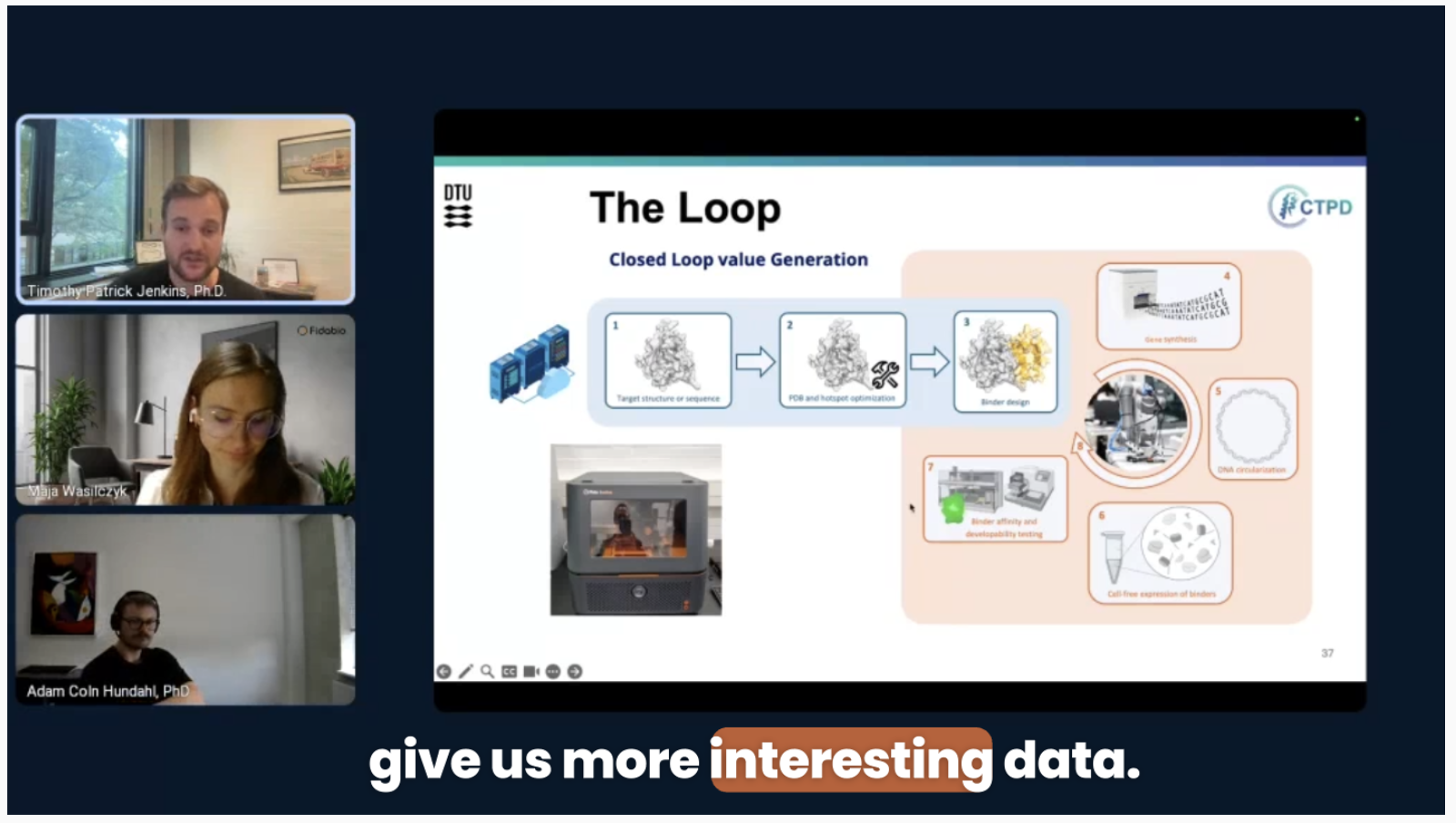
The wider effort Dr. Timothy Jenkins described is a strategic partnership between Novo Nordisk and DTU, nicknamed the closed loop for binder design: an automated platform that takes a target sequence, works out how best to approach it, designs candidate reagents, diagnostics or therapeutics, expresses them cell-free and screens them, then feeds the results back into the next design round. He described it as already operational, with features still being added.
Cell-free expression, is excellent for automation but expensive, which puts a premium on low sample volumes. Dr. Jenkins' words group went looking for something faster, cheaper and capable of producing more interesting data. What they landed on was FIDA, for reasons he listed plainly: binding measured in solution, no need to purify the sample, low volumes, a cost that works at screening scale, and, in the new Fida Evolve, an instrument that fits an automated workflow.
''BLI and SBR can be both annoying and expensive. And we were looking at least at alternative technologies that could be potentially faster, cheaper, and also give us more interesting data. And so we explored this and we landed on FIDA.'' Professor Jenkins said.
What is the role of FIDA in this de novo protein loop?
Professor Jenkins described using it first as a rapid yes-or-no binding screen on the automation-friendly Fida Evolve, then for target quality control, checking whether a bought-in protein is aggregated or pure before effort is wasted on it, and for measuring binding affinity directly in solution.
"You actually are able to test in-solution binding, we don't really need to purify our sample, we can use low volume. It is not so expensive and it is also automation friendly, at least the new Fida Evolve,"
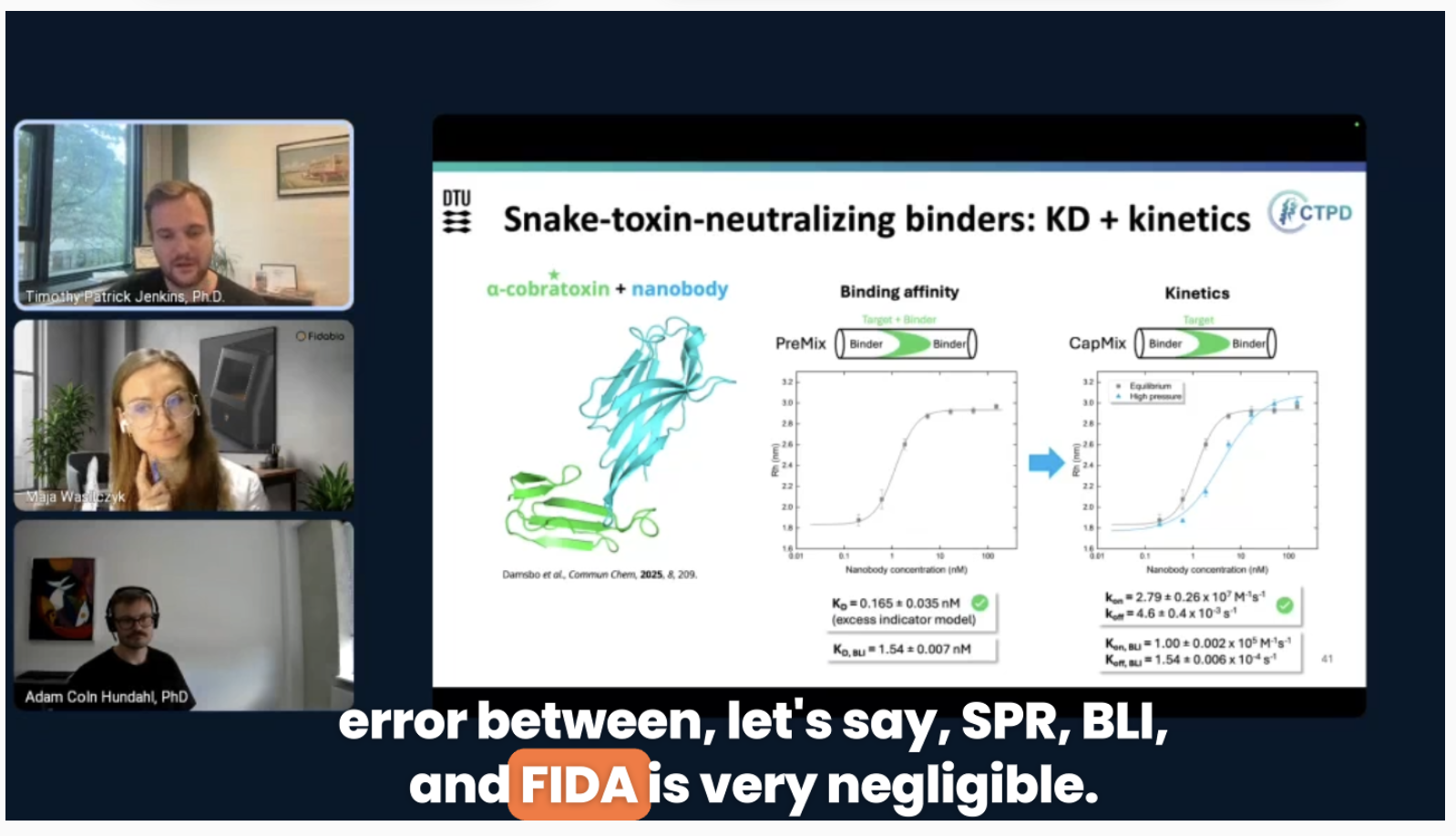
Crucially, the numbers held up against the established methods. According to Professor Jenkins, the affinities FIDA returned were close to identical to those from BLI across around ten different formats and targets.
"The error between SPR, BLI and FIDA is very negligible, it is always within the same order of magnitude," Professor Jenkins said.
FIDA now sits inside a larger effort he called the closed loop for binder design, a strategic partnership between Novo Nordisk and DTU that aims to design, express and test binders in one automated cycle, with FIDA as the measurement step.
Across that workflow, the group now uses FIDA for:
- Binding, yes or no: rapid screens of designed variants, including in crude matrices; blood plasma among them.
- Target QC: whether an outsourced target is pure, aggregated, monomeric, dimeric or trimeric, before it costs a campaign. As Dr. Jenkins put it, vendors will tell you everything, and anyone who has bought proteins knows they do not always work, so it is useful to know quickly where the problem lies.
- Affinity and kinetics: full binding curves and rate constants from the same setup.
- Stickiness, buffers and stability: flagging material that sticks, screening buffer conditions, and crude thermostability checks
What it means for protein design
Professor Jenkins framed the shift as one of the largest in pharmaceuticals: discovery timelines that once ran to years are being rewritten to months, and design can now outpace testing. When design moves that fast, measurement has to keep up. FIDA's appeal, in his account, is that it reads binding, size, sample quality and affinity from small, unpurified samples in solution, on an automation-friendly instrument, so the testing step no longer holds the design loop back.
Curious how FIDA measures binding, size and sample quality in solution? Explore the FIDA technology and the Fida instrument, see how FIDA supports de novo protein design, or browse the peer-reviewed literature. You can also watch the full webinar with Professor Timothy Jenkins.
.png)
.png)