Dig deeper:
Applications, Webinars, Posters
Publications and more...
Thank you! Your submission has been received!
Oops! Something went wrong while submitting the form.



Publications
Cross-regulation of [2Fe–2S] cluster synthesis by ferredoxin-2 and frataxin

Author Information

Kristian Want, Hubert Gorny, Ema Turki, Magali Noiray, Beata Monfort, Rémi Mor-Gautier, Thibault Tubiana, Estelle Jullian, Véronique Monnier & Benoit D’Autréaux
Nature 2026
Publications
2026
No items found.

Application Notes
Smarter workflow. Earlier insight. Confident decisions. Combining the power of Biacore™ SPR and FIDA™ technologies.
Author Information
Murthy Narasimha Bandaru, PhD Scientist, Cytiva Anna Moberg Senior manager, Cytiva
Application Notes
2025


Posters
FIDA for the evaluation of de novo designed binders
Author Information
Francisca Pinheiro, Jan S. Nowak, Elena Zueva, Emily C. Pheasant, Ida K. Grene, Vili Lampinen, Magnus Kjærgaard
Posters
2026

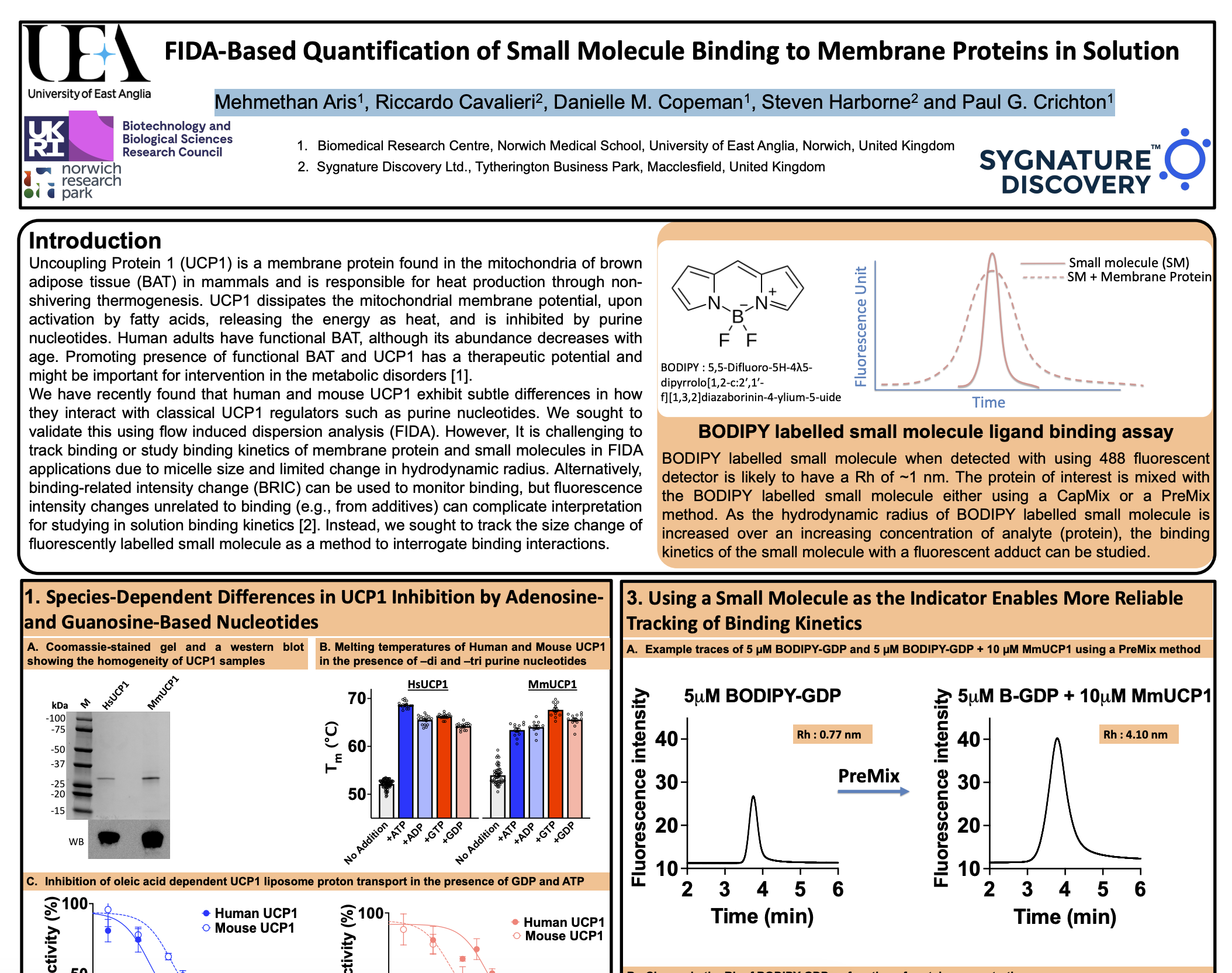
FIDA-Based Quantification of Small Molecule Binding to Membrane Proteins in Solution
Author Information
Mehmethan Aris, Riccardo Cavalieri, Danielle M. Copeman , Steven Harborne and Paul G. Crichton
2026

Posters
Chaperone triaging on the fate of aggregating proteins.
Author Information
Elena Timoshenko , Stefan G.D.Rüdiger
Posters
2026

Brochures
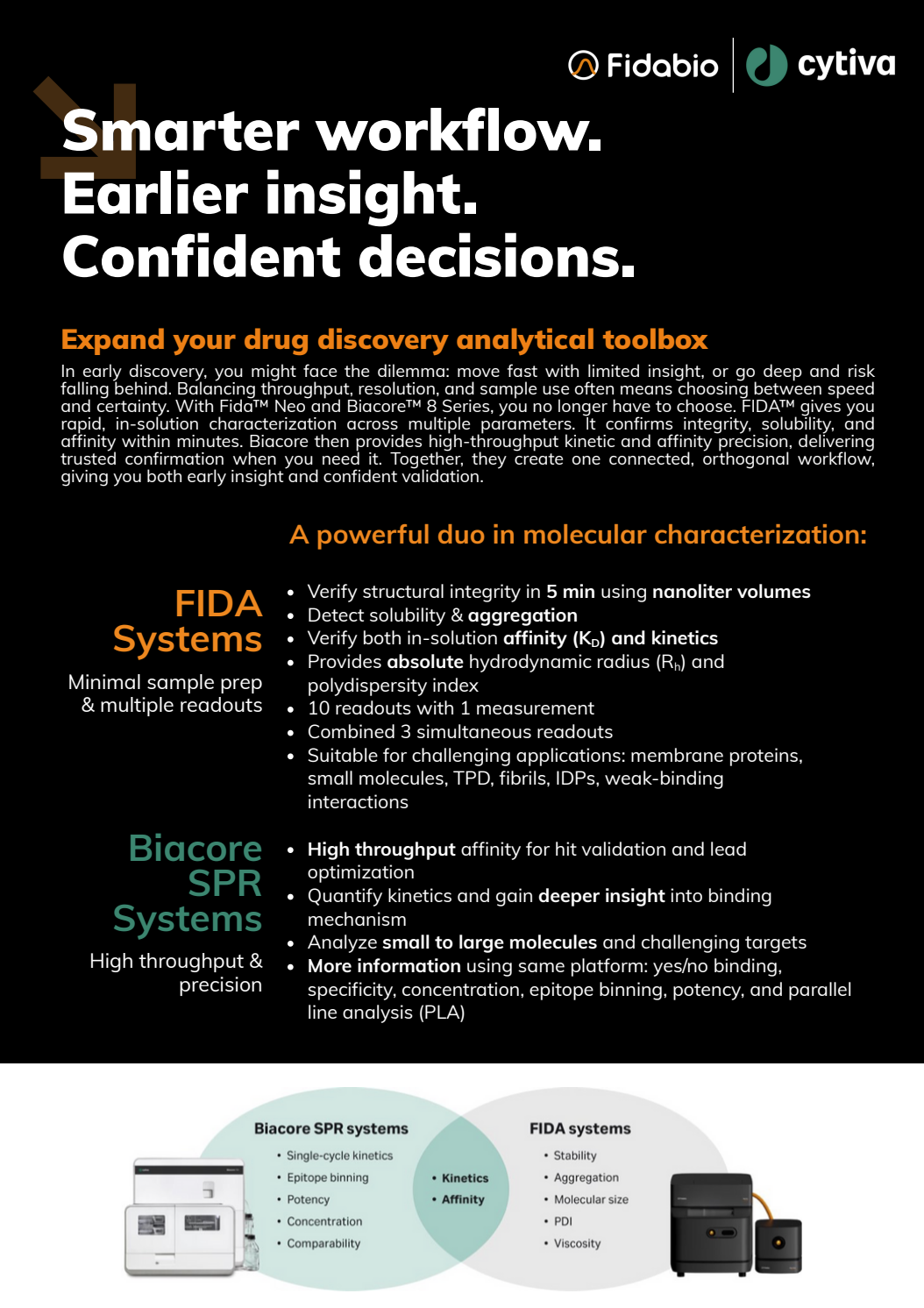
A powerful duo in molecular characterization: FIDA System + SPR Biacore System
Author Information
Brochures
2025

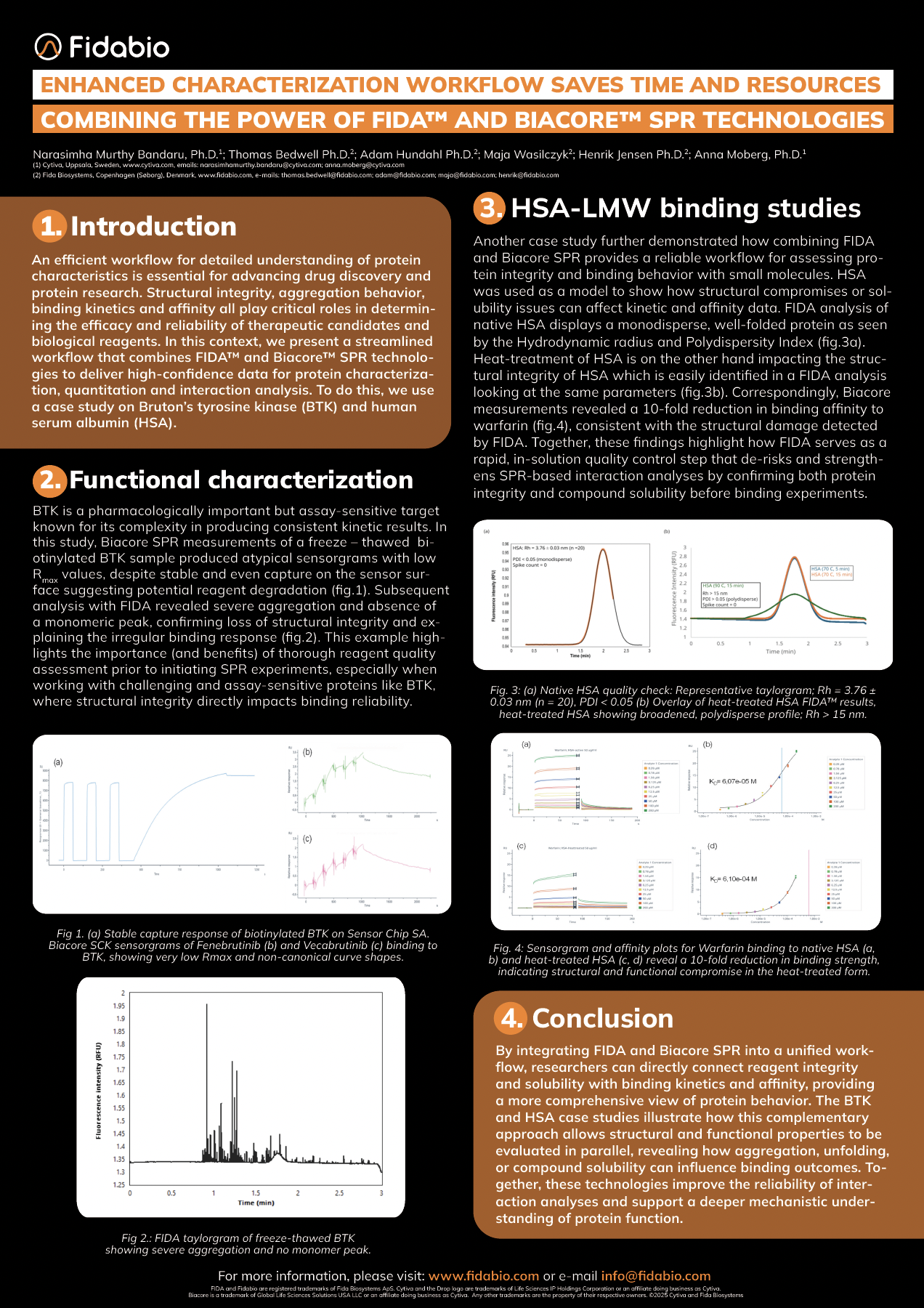
Enhanced characterization workflow saves time and resources combining the power of FIDA™ and Biacore™ SPR technologies
Author Information
Narasimha Murthy Bandaru, Ph.D.; Thomas Bedwell Ph.D.; Adam Hundahl Ph.D.; Maja Wasilczyk; Henrik Jensen Ph.D.; Anna Moberg, Ph.D.
2025


Publications
Intracellular TDP-43 amyloid nucleates from arrested nascent condensates
Author Information
anzheng Wu, Shriram Venkatesan, Jacob Jensen, Tayla Miller, Jeffrey J. Lange, Sean McKinney, Einar Halldorsson, Zulin Yu, Vignesh Babu, Laura Sancho Salazar, Jeff Haug, Jay Unruh, Randal Halfmann
bioRxiv (preprint) 2026
Publications
2026

Publications
The potential effect of albumin replacement on immune modulation and sphingosine 1-phosphate dynamics
Author Information
M. S. Winkler, F. Enzmann, M. Schilder, I. Seidita, O. Moerer & M. H. Gräler
Scientific Reports 2026
Publications
2026


Publications
Universal functionalization of extracellular vesicles with nanobody adapters
Author Information
Andrea Galisova, Jiri Zahradnik, Ester Merunkova, Dominik Havlicek, Josef Uskoba, Ziv Porat, Daniel Jirak
bioRxiv (preprint) 2026
Publications
2026


Literature
Rapid, Precise Information for Fast and Safe Drug Development
Based on our revolutionary, patented FIDA technology, Fidabio offers rapid, precise information on complex binding interactions and concentration of proteins, particles up to 1,000 nm Dh, antibodies, and other biomolecules.
The core measurements of the FIDA technology, or Flow-Induced-Dispersion- Analysis, are very precise and reproducible, absolute detections of hydrodynamic radii directly in plasma, serum, fermentation media, cell lysate etc. with accuracies of +/- 5 %, coefficient of variations of <5 % and a sensitivity of 0.1 nM FITC type tags. The instrument is fully automated for vials or 2 x 96 wells plates with end-to-end temperature control from 4-55 °C controllable in increments of 0.1 °C. Each test only requires a few hundred nanoliters of sample material.
The FIDA technology provides significant advantages over current technologies in terms of data quality, cost, versatility and time. In other words, Fidabio enables scientists and researchers to carry out tests that are impossible using current technologies leading to faster and safer drug development.



Fida 1 Overview

Fida 1 Fundamentals: Assessment of Sample Quality with every measurement
Poster: Assessment of sample quality with every measurement – Fida 1 Fundamentals
Technote: The Relationship between hydrodynamic radius and molecular weight
Analysis of Large Particles
The FIDA technology allows the analysis of proteins and particles 0.5 to 1,000 nm in diameter. This enables analysis of exosomes, liposomes, vaccines, viral vectors, membrane-embedded proteins, intrinsically disordered proteins et. al.
With the Fidabio instrument you can amongst others analyse interactions between targets and membrane proteins and vaccines, characterization of exosomes, liposome and IDPs, quantification of specific exosomes in plasma, quantification of viral vectors in fermentation media etc.
With the Fidabio instrument you can amongst others analyse interactions between targets and membrane proteins and vaccines, characterization of exosomes, liposome and IDPs, quantification of specific exosomes in plasma, quantification of viral vectors in fermentation media etc.

Analysis Directly in Complex Matrices
It is well-known that detection in a buffer, sample preparations and immobilization from time to time impact the data reliability. Detection directly under native conditions ensures you that your decisions are based on the most biologically accurate data.
The FIDA technology is based on in-solution measurements. You can analyze directly in plasma, serum, cell lysate, fermentation media, CHO cells et al. Background noise is eliminated by an automatic adjustment of the baseline and the risk of adsorption is managed with our advanced, proprietary capillary coating.
The FIDA technology is based on in-solution measurements. You can analyze directly in plasma, serum, cell lysate, fermentation media, CHO cells et al. Background noise is eliminated by an automatic adjustment of the baseline and the risk of adsorption is managed with our advanced, proprietary capillary coating.
In-solution Validation Immobilization Data
SPR and BLI are industry standards and are widely used for amongst others affinity Kd determination. Though often robust and reliable, occasionally the surface immobilization might result in difficult-to-interpret artefacts due to mass transport limitations.
With easy setup and validation of new assays and the consumption of only a few hundred nanoliters of sample material, the Fidabio instrument offers a possibility of fast and accurate orthogonal validation of Kd data generated with SPR, BLI etc.
With easy setup and validation of new assays and the consumption of only a few hundred nanoliters of sample material, the Fidabio instrument offers a possibility of fast and accurate orthogonal validation of Kd data generated with SPR, BLI etc.