Dig deeper:
Applications, Webinars, Posters
Publications and more...
Thank you! Your submission has been received!
Oops! Something went wrong while submitting the form.



Brochures
Biophysical Characterisation for Hit Identification and Validation: The role of FIDA (Handbook)

Author Information

Katie West, Ph.D.; Maja Wasilczyk
Brochures
2026



Publications
Mechanistic insights into Enterocin C targeting the undecaprenyl phosphate recycling protein BacA
Author Information
Folcher, Touzé, et.al.
bioRxiv (preprint) 2025
Publications
2025

Publications
A Benzarone Derivative Inhibits EYA to Suppress Tumor Growth in SHH Medulloblastoma
Author Information
Grace H. Hwang, Maria F. Pazyra-Murphy, Hyuk-Soo Seo, Sirano Dhe-Paganon, Sylwia A. Stopka, Marina DiPiazza, Nizhoni Sutter, Thomas W. Gero, Alison Volkert, Lincoln Ombelets, Georgia Dittemore, Matthew G. Rees, Melissa M. Ronan, Jennifer A. Roth, Nathalie Y.R. Agar, David A. Scott, Rosalind A. Segal
Cancer Research 2024
Publications
2024

Videos
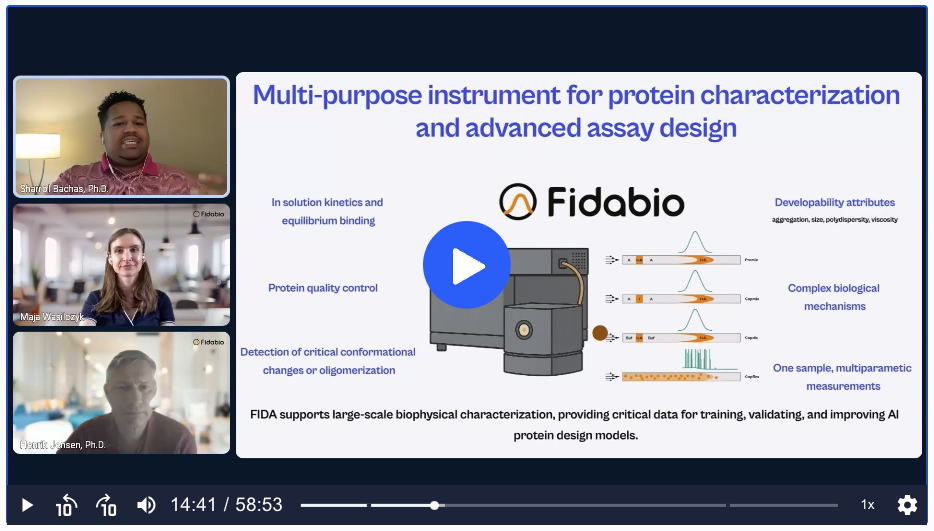
Designing Proteins with Rapid AI–Lab Iterations: using FIDA to quantify in-solution protein behavior.
Author Information
Sharrol Bachas, Ph.D.
Videos
2026


Optimizing Solution-Phase Epitope Mapping with ALFA-Tagged Peptides and FIDA
Author Information
Dina Kalloubi, Abdul Jabbar Kali, Pia Søndergaard Galle, and Stefán Bragi Gunnarsson
2026

Posters
Exploring Drug Interactions: A Sneak Peek with FIDA
Author Information
Revati Kulkarni, Jimmi Gabrielsen, Rita Wulff Rasmussen, Jesper Østergaard
Posters
2026

Posters
The Protein Binder Printer: Fully Automated Closed-Loop AI-Driven Protein Binder Design
Author Information
Diego Ruiz Espi; G. Avelar Molina; A. Ljungars A. Hald;, E. Rivera de Torre; T.P. Jenkins
Posters
2026


Videos
Solving difficult cases at core facilities. How FIDA has proved surprisingly useful at the Biozentrum, Basel
Author Information
Timothy Sharpe, Ph.D.; Thomas Bedwell, Ph.D.; Maja Wasilczyk
Videos
2026

Videos
Can Kd Be Determined in 1 Minute? Speeding up Your Small Molecule Work.
Author Information
Philipp Willmer, Ph.D.
Videos
2026

Publications
Flow-induced dispersion analysis for probing cyclodextrin–guest binding interactions
Author Information
Josef Hamacek and Federico Perche
European Biophysics Journal 2026
Publications
2026


Publications
Targeting the Interaction of NRF2 and β-TrCP with Molecular Glues
Author Information
Daniel H. O Donovan, Jon Winter-Holt, Gavin W. Collie, Maria Emanuela Cuomo, David John McGarry, Millie Fox, Bo Kyung Alex Seong, Ursula Grazini, Peter Barton, David Longmire, Andrew Lister, Yong Xu, Hazel Mak, Evelyne J. Barrey, Marta Acebrón-García-de-Eulate, Magdalena Richter, Nisha Peter, Maxime Couturier, Gustavo J. Gutierrez, Ryan Guilbert, Wankyu Lee, Pamela A. Lochhead, Argyrides Argyrou
ACS Chemical Biology 2026
Publications
2026
Literature
Rapid, Precise Information for Fast and Safe Drug Development
Based on our revolutionary, patented FIDA technology, Fidabio offers rapid, precise information on complex binding interactions and concentration of proteins, particles up to 1,000 nm Dh, antibodies, and other biomolecules.
The core measurements of the FIDA technology, or Flow-Induced-Dispersion- Analysis, are very precise and reproducible, absolute detections of hydrodynamic radii directly in plasma, serum, fermentation media, cell lysate etc. with accuracies of +/- 5 %, coefficient of variations of <5 % and a sensitivity of 0.1 nM FITC type tags. The instrument is fully automated for vials or 2 x 96 wells plates with end-to-end temperature control from 4-55 °C controllable in increments of 0.1 °C. Each test only requires a few hundred nanoliters of sample material.
The FIDA technology provides significant advantages over current technologies in terms of data quality, cost, versatility and time. In other words, Fidabio enables scientists and researchers to carry out tests that are impossible using current technologies leading to faster and safer drug development.



Fida 1 Overview

Fida 1 Fundamentals: Assessment of Sample Quality with every measurement
Poster: Assessment of sample quality with every measurement – Fida 1 Fundamentals
Technote: The Relationship between hydrodynamic radius and molecular weight
Analysis of Large Particles
The FIDA technology allows the analysis of proteins and particles 0.5 to 1,000 nm in diameter. This enables analysis of exosomes, liposomes, vaccines, viral vectors, membrane-embedded proteins, intrinsically disordered proteins et. al.
With the Fidabio instrument you can amongst others analyse interactions between targets and membrane proteins and vaccines, characterization of exosomes, liposome and IDPs, quantification of specific exosomes in plasma, quantification of viral vectors in fermentation media etc.
With the Fidabio instrument you can amongst others analyse interactions between targets and membrane proteins and vaccines, characterization of exosomes, liposome and IDPs, quantification of specific exosomes in plasma, quantification of viral vectors in fermentation media etc.

Analysis Directly in Complex Matrices
It is well-known that detection in a buffer, sample preparations and immobilization from time to time impact the data reliability. Detection directly under native conditions ensures you that your decisions are based on the most biologically accurate data.
The FIDA technology is based on in-solution measurements. You can analyze directly in plasma, serum, cell lysate, fermentation media, CHO cells et al. Background noise is eliminated by an automatic adjustment of the baseline and the risk of adsorption is managed with our advanced, proprietary capillary coating.
The FIDA technology is based on in-solution measurements. You can analyze directly in plasma, serum, cell lysate, fermentation media, CHO cells et al. Background noise is eliminated by an automatic adjustment of the baseline and the risk of adsorption is managed with our advanced, proprietary capillary coating.
In-solution Validation Immobilization Data
SPR and BLI are industry standards and are widely used for amongst others affinity Kd determination. Though often robust and reliable, occasionally the surface immobilization might result in difficult-to-interpret artefacts due to mass transport limitations.
With easy setup and validation of new assays and the consumption of only a few hundred nanoliters of sample material, the Fidabio instrument offers a possibility of fast and accurate orthogonal validation of Kd data generated with SPR, BLI etc.
With easy setup and validation of new assays and the consumption of only a few hundred nanoliters of sample material, the Fidabio instrument offers a possibility of fast and accurate orthogonal validation of Kd data generated with SPR, BLI etc.