Dig deeper:
Applications, Webinars, Posters
Publications and more...
Thank you! Your submission has been received!
Oops! Something went wrong while submitting the form.



Publications
Multimodal Nanobiophysical Profiling of Melanoma-Derived Small Extracellular Vesicles Reveals Glycan Signatures Associated with Tumor Progression

Author Information

Kasarla, S., Staniak, K., Surman, M., Zajączkowski, K., Targońska, A., Mosieniak, G., … Kobiela, T.
Nanotechnology, Science and Applications 2025
Publications
2025


Publications
A degron-mimicking molecular glue drives CRBN homo-dimerization and degradation
Author Information
Langousis, G., Gainza, P., Hunkeler, M. et al.
Nature Communications 2025
Publications
2025

Publications
Thermodynamic Stability Modulates Chaperone-Mediated Disaggregation of α-Synuclein Fibrils
Author Information
C. Fricke, A. Kunka, R. K. Norrild, S. Wang, T. Dang, J. Folke, M. Shahnawaz, C. A. Soto, S. Aznar, A. Wentink, B. Bukau and A. Buell
Chemical Science 2025
Publications
2025

Publications
Probing the energy landscape of α-Synuclein amyloid fibril formation by systematic K-to-Q mutagenesis
Author Information
Antonin Kunka, Azad Farzadfard, Jacob Aunstrup Larsen, Federica Saraceno, Rasmus Krogh Norrild, Celia Fricke, Hossein Mohammad-Beigi, Ahmed Sadek, Jonas Folke, Susana Aznar, Alexander Kai Buell
bioRxiv (preprint) 2025
Publications
2025

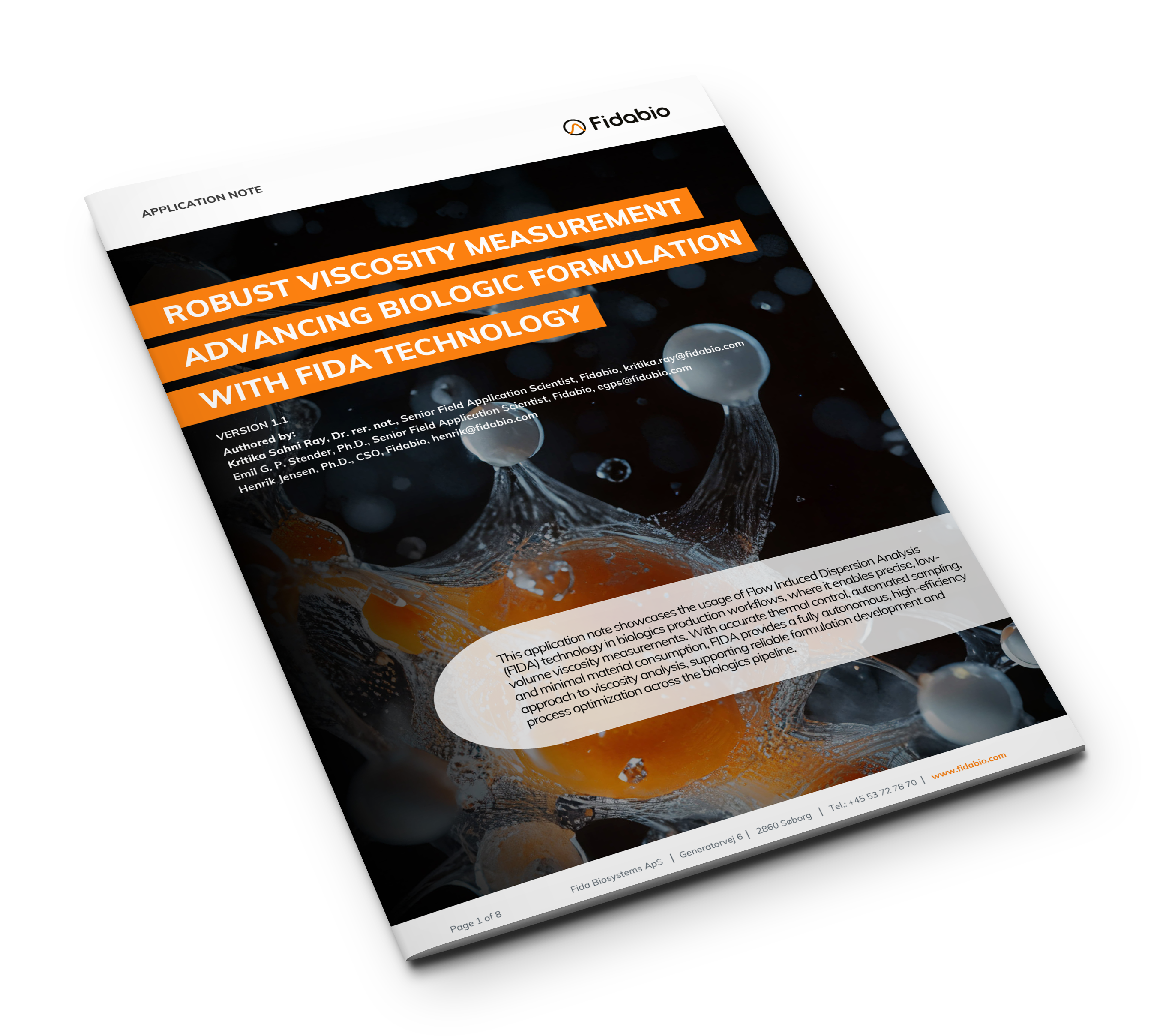
Application Notes
Robust Viscosity Measurement. Advancing Biologic formulation with FIDA Technology
Author Information
Robust Viscosity Measurement. Advancing Biologic formulation with FIDA Technology
Kritika Sahni Ray, Dr. rer. nat.; Emil G. P. Stender, Ph.D.
Application Notes
2025
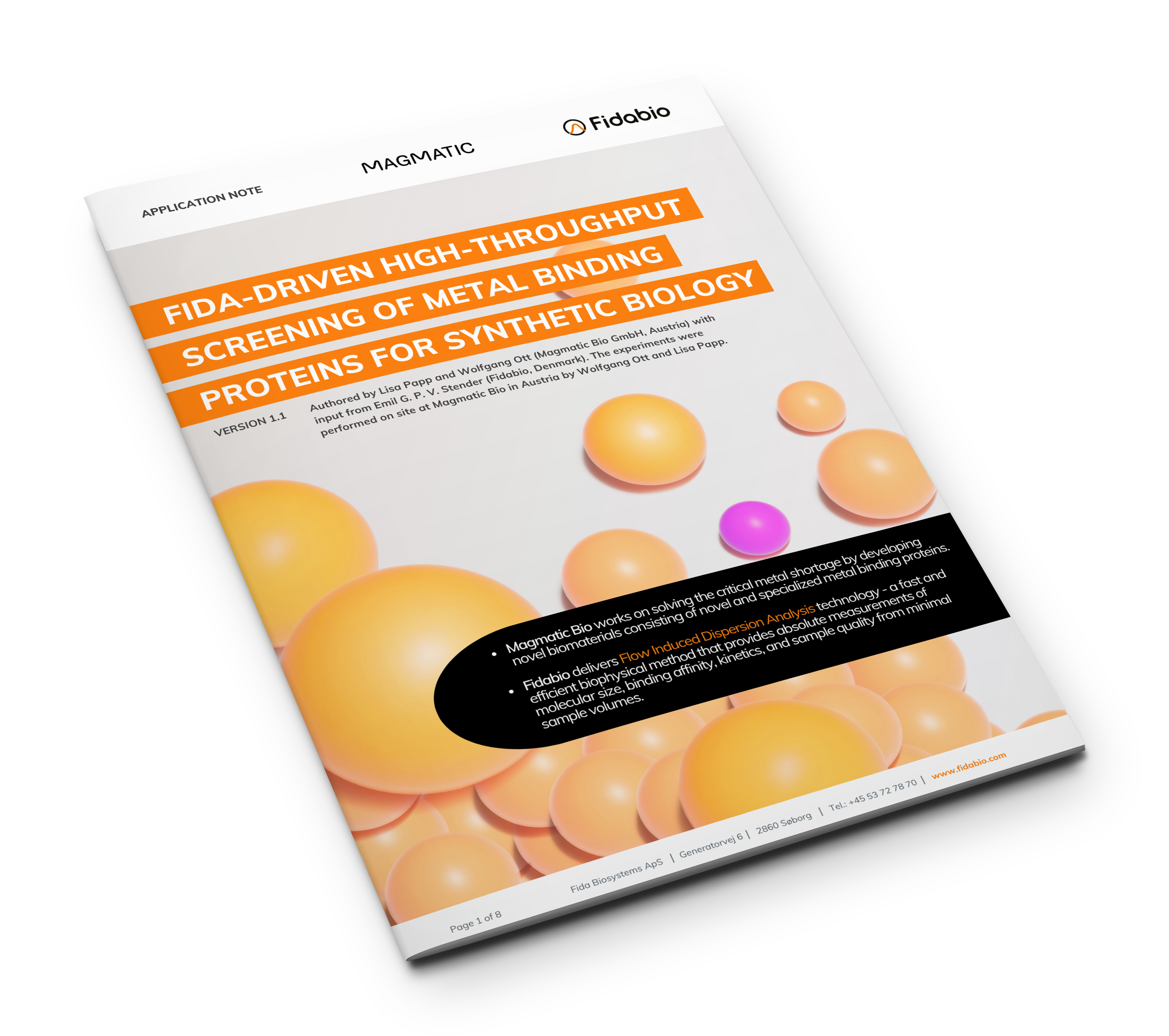
Application Notes
FIDA-Driven High-Throughput Screening of Metal Binding Proteins for Synthetic Biology
Author Information
FIDA-Driven High-Throughput Screening of Metal Binding Proteins for Synthetic Biology
Lisa Papp & Wolfgang Ott
Application Notes
2025


Videos
How to screen de novo designed protein binders in unpurified lysate using flow induced dispersion analysis?
Author Information
Magnus Kjæregaard, Ph.D.
Videos
2025


Publications
Engineered heat-stable variants of Trypanosoma cruzi flagellar protein Tc24 enable serological detection of Chagas disease
Author Information
Sagar Batra, Christopher Waugh, Gemma Harris, Frederick W. Muskett, Tiberiu-Marius Gianga, Rohanah Hussain, Giuliano Siligardi, Laurence Turpin, Mallory Draye, Pascal Mertens, Barrie Rooney, Michael Miles, Tapan Bhattacharyya, Ivan Campeotto
bioRxiv (preprint) 2025
Publications
2025

Publications
Phase separation of protein kinase A regulatory subunits is driven by similar inter- and intra-molecular interactions involving the inhibitory segment
Author Information
Malyasree Giri, Christopher S. Brasnett, Kübra F. Eroglu, Julie Maibøll Kaasen, Alain A.M. Andre, Siewert-Jan Marrink, Frans A.A. Mulder, Magnus Kjaergaard
bioRxiv (preprint) 2025
Publications
2025

Publications
Investigating Weak Polypeptide-Cyclodextrin Interactions in Biologic Formulation Development using Affinity CE and FIDA
Author Information
Yunxiao Zhu, Sharadvi Thati, Megan Mccallum, Rao Mantri, William Ying, Neil Mathias, Mark Bolgar, Wenkui Lan
Electrophoresis 2025
Publications
2025


Publications
Native Flow-Induced Dispersion Analysis – Mass Spectrometry Enables Automated, Multiplexed Ligand Screening from Conventional, Nonvolatile Buffers
Author Information
Edvaldo Vasconcelos Soares Maciel, Jonathan Eisert, Verena Dederer, Aylin Berwanger, Stefan Knapp, Martin Empting, Sebastian Mathea, Henrik Jensen, and Frederik Lermyte
Analytical Chemistry 2025
Publications
2025

Publications
Quaternary stabilization of a GH2 beta-galactosidase from the psychrophile A. ikkensis, a flexible and unstable dimeric enzyme
Author Information
Jan S. Nowak, Nikoline Kruuse, Helena Ø. Rasmussen, Pengfei Tian, Julie Astono, Søren Schultz-Nielsen, Mariane S. Thøgersen, Peter Stougaard, Jan Skov Pedersen, Daniel E. Otzen
Protein Science 2025
Publications
2025
Literature
Rapid, Precise Information for Fast and Safe Drug Development
Based on our revolutionary, patented FIDA technology, Fidabio offers rapid, precise information on complex binding interactions and concentration of proteins, particles up to 1,000 nm Dh, antibodies, and other biomolecules.
The core measurements of the FIDA technology, or Flow-Induced-Dispersion- Analysis, are very precise and reproducible, absolute detections of hydrodynamic radii directly in plasma, serum, fermentation media, cell lysate etc. with accuracies of +/- 5 %, coefficient of variations of <5 % and a sensitivity of 0.1 nM FITC type tags. The instrument is fully automated for vials or 2 x 96 wells plates with end-to-end temperature control from 4-55 °C controllable in increments of 0.1 °C. Each test only requires a few hundred nanoliters of sample material.
The FIDA technology provides significant advantages over current technologies in terms of data quality, cost, versatility and time. In other words, Fidabio enables scientists and researchers to carry out tests that are impossible using current technologies leading to faster and safer drug development.



Fida 1 Overview

Fida 1 Fundamentals: Assessment of Sample Quality with every measurement
Poster: Assessment of sample quality with every measurement – Fida 1 Fundamentals
Technote: The Relationship between hydrodynamic radius and molecular weight
Analysis of Large Particles
The FIDA technology allows the analysis of proteins and particles 0.5 to 1,000 nm in diameter. This enables analysis of exosomes, liposomes, vaccines, viral vectors, membrane-embedded proteins, intrinsically disordered proteins et. al.
With the Fidabio instrument you can amongst others analyse interactions between targets and membrane proteins and vaccines, characterization of exosomes, liposome and IDPs, quantification of specific exosomes in plasma, quantification of viral vectors in fermentation media etc.
With the Fidabio instrument you can amongst others analyse interactions between targets and membrane proteins and vaccines, characterization of exosomes, liposome and IDPs, quantification of specific exosomes in plasma, quantification of viral vectors in fermentation media etc.

Analysis Directly in Complex Matrices
It is well-known that detection in a buffer, sample preparations and immobilization from time to time impact the data reliability. Detection directly under native conditions ensures you that your decisions are based on the most biologically accurate data.
The FIDA technology is based on in-solution measurements. You can analyze directly in plasma, serum, cell lysate, fermentation media, CHO cells et al. Background noise is eliminated by an automatic adjustment of the baseline and the risk of adsorption is managed with our advanced, proprietary capillary coating.
The FIDA technology is based on in-solution measurements. You can analyze directly in plasma, serum, cell lysate, fermentation media, CHO cells et al. Background noise is eliminated by an automatic adjustment of the baseline and the risk of adsorption is managed with our advanced, proprietary capillary coating.
In-solution Validation Immobilization Data
SPR and BLI are industry standards and are widely used for amongst others affinity Kd determination. Though often robust and reliable, occasionally the surface immobilization might result in difficult-to-interpret artefacts due to mass transport limitations.
With easy setup and validation of new assays and the consumption of only a few hundred nanoliters of sample material, the Fidabio instrument offers a possibility of fast and accurate orthogonal validation of Kd data generated with SPR, BLI etc.
With easy setup and validation of new assays and the consumption of only a few hundred nanoliters of sample material, the Fidabio instrument offers a possibility of fast and accurate orthogonal validation of Kd data generated with SPR, BLI etc.