Dig deeper:
Applications, Webinars, Posters
Publications and more...
Thank you! Your submission has been received!
Oops! Something went wrong while submitting the form.



Application Notes
Size-based characterization of peptide-liposome interactions

Author Information

Size-based characterization of peptide-liposome interactions
Application Notes


Application Notes
Easy and Rapid Assessment of Protein ubiquitination, e.g. in PROTAC development
Author Information
Easy and Rapid Assessment of Protein ubiquitination, e.g. in PROTAC development
Nadia Mirza, PhD
Application Notes


Application Notes
Selective quantification of IgG Directly in F12 Fermentation Media
Author Information
Selective quantification of IgG Directly in F12 Fermentation Media
Application Notes


Application Notes
Functional Characterization of Nanodisc embedded GPCR
Author Information
Functional Characterization of Nanodisc embedded GPCR
Riccardo Marabini, PhD
Application Notes
Application Notes
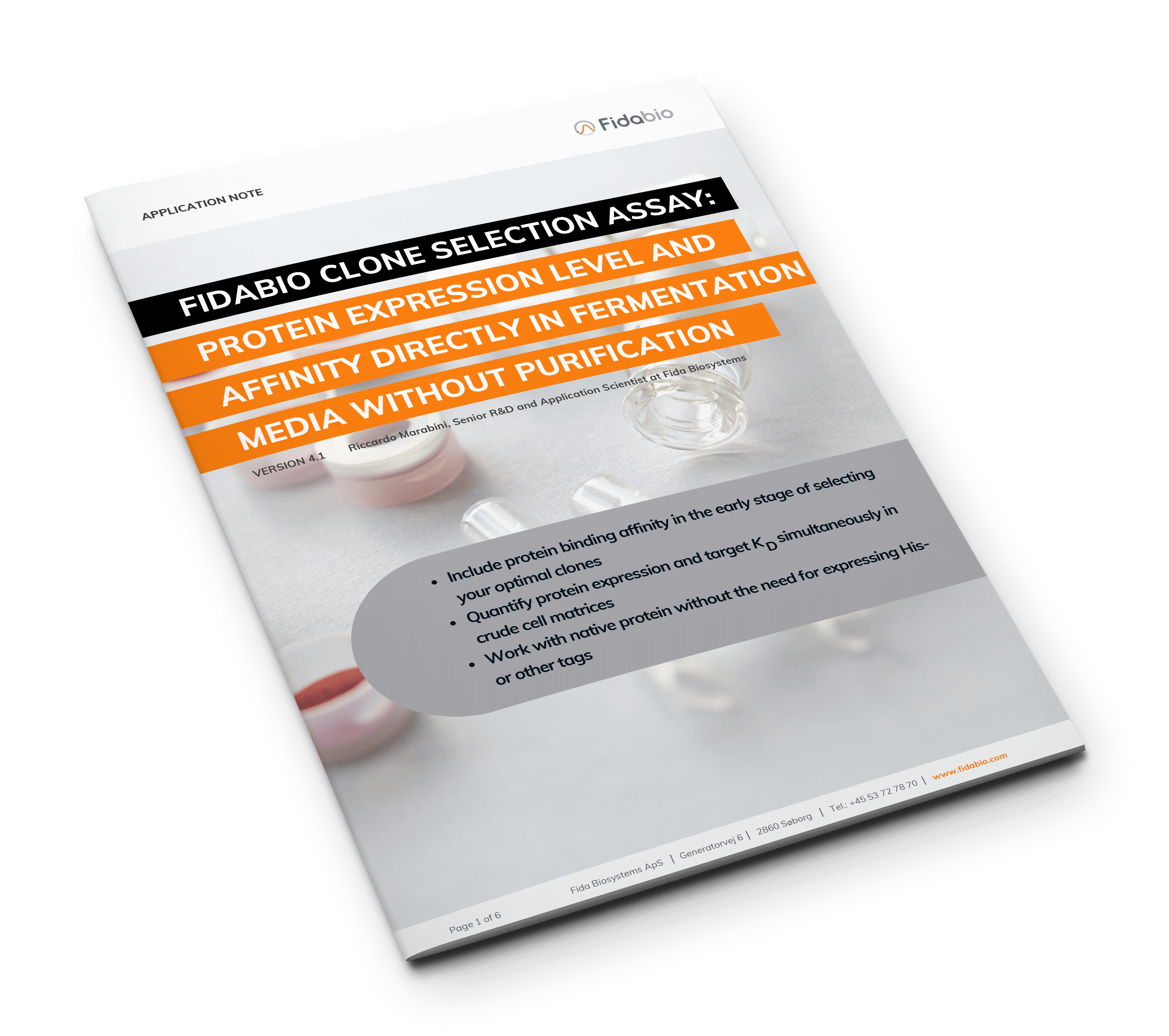
Fidabio Clone Selection Assay: Protein Expression Level and affinity directly in fermentation media without purification (Clone Selection from Non-Purified Samples)
Author Information
Fidabio Clone Selection Assay: Protein Expression Level and affinity directly in fermentation media without purification
Riccardo Marabini, PhD
Application Notes


Application Notes
Characterization of Conformational Changes by flow induced dispersion analysis
Author Information
Characterization of Conformational Changes by Flow Induced Dispersion Analysis
Dr Melanie Hug
Application Notes

Application Notes
Detection of Auto-Antibodies in Systemic Lupus Erythematosus Patients
Author Information
Detection of Auto-Antibodies in Systemic Lupus Erythematosus Patients
Morten E. Pedersen, PhD.
Application Notes
2021

Application Notes
Characterizing Multivalent Complex Formation (Agglutination of multivalent antibodies)
Author Information
Characterizing Multivalent Complex Formation
Emil Georg Palmkvist Vangsgaard Stender, PhD
Application Notes
2023


Literature
Rapid, Precise Information for Fast and Safe Drug Development
Based on our revolutionary, patented FIDA technology, Fidabio offers rapid, precise information on complex binding interactions and concentration of proteins, particles up to 1,000 nm Dh, antibodies, and other biomolecules.
The core measurements of the FIDA technology, or Flow-Induced-Dispersion- Analysis, are very precise and reproducible, absolute detections of hydrodynamic radii directly in plasma, serum, fermentation media, cell lysate etc. with accuracies of +/- 5 %, coefficient of variations of <5 % and a sensitivity of 0.1 nM FITC type tags. The instrument is fully automated for vials or 2 x 96 wells plates with end-to-end temperature control from 4-55 °C controllable in increments of 0.1 °C. Each test only requires a few hundred nanoliters of sample material.
The FIDA technology provides significant advantages over current technologies in terms of data quality, cost, versatility and time. In other words, Fidabio enables scientists and researchers to carry out tests that are impossible using current technologies leading to faster and safer drug development.



Fida 1 Overview

Fida 1 Fundamentals: Assessment of Sample Quality with every measurement
Poster: Assessment of sample quality with every measurement – Fida 1 Fundamentals
Technote: The Relationship between hydrodynamic radius and molecular weight
Analysis of Large Particles
The FIDA technology allows the analysis of proteins and particles 0.5 to 1,000 nm in diameter. This enables analysis of exosomes, liposomes, vaccines, viral vectors, membrane-embedded proteins, intrinsically disordered proteins et. al.
With the Fidabio instrument you can amongst others analyse interactions between targets and membrane proteins and vaccines, characterization of exosomes, liposome and IDPs, quantification of specific exosomes in plasma, quantification of viral vectors in fermentation media etc.
With the Fidabio instrument you can amongst others analyse interactions between targets and membrane proteins and vaccines, characterization of exosomes, liposome and IDPs, quantification of specific exosomes in plasma, quantification of viral vectors in fermentation media etc.

Analysis Directly in Complex Matrices
It is well-known that detection in a buffer, sample preparations and immobilization from time to time impact the data reliability. Detection directly under native conditions ensures you that your decisions are based on the most biologically accurate data.
The FIDA technology is based on in-solution measurements. You can analyze directly in plasma, serum, cell lysate, fermentation media, CHO cells et al. Background noise is eliminated by an automatic adjustment of the baseline and the risk of adsorption is managed with our advanced, proprietary capillary coating.
The FIDA technology is based on in-solution measurements. You can analyze directly in plasma, serum, cell lysate, fermentation media, CHO cells et al. Background noise is eliminated by an automatic adjustment of the baseline and the risk of adsorption is managed with our advanced, proprietary capillary coating.
In-solution Validation Immobilization Data
SPR and BLI are industry standards and are widely used for amongst others affinity Kd determination. Though often robust and reliable, occasionally the surface immobilization might result in difficult-to-interpret artefacts due to mass transport limitations.
With easy setup and validation of new assays and the consumption of only a few hundred nanoliters of sample material, the Fidabio instrument offers a possibility of fast and accurate orthogonal validation of Kd data generated with SPR, BLI etc.
With easy setup and validation of new assays and the consumption of only a few hundred nanoliters of sample material, the Fidabio instrument offers a possibility of fast and accurate orthogonal validation of Kd data generated with SPR, BLI etc.