What size range can FIDA measure, and how precise is it?
Flow Induced Dispersion Analysis (FIDA) measures the size of molecules and particles in solution, as hydrodynamic radius, from small molecules and peptides up to nanoparticles and virus-like particles. Its precision is enough to follow binding, conformational changes and unfolding.
Which protein analysis instrument measures absolute hydrodynamic radius accurately?
Fida instruments, which use Flow Induced Dispersion Analysis (FIDA), measure the absolute hydrodynamic radius of proteins in solution. The measurement is based on first principles, so it is independent of assumptions and calibration: the hydrodynamic radius comes from Taylor dispersion and the Stokes-Einstein equation, with the sample viscosity measured in every run. For most systems, FIDA reproducibly detects size changes of as little as 1%.
What are the size measurement limits?
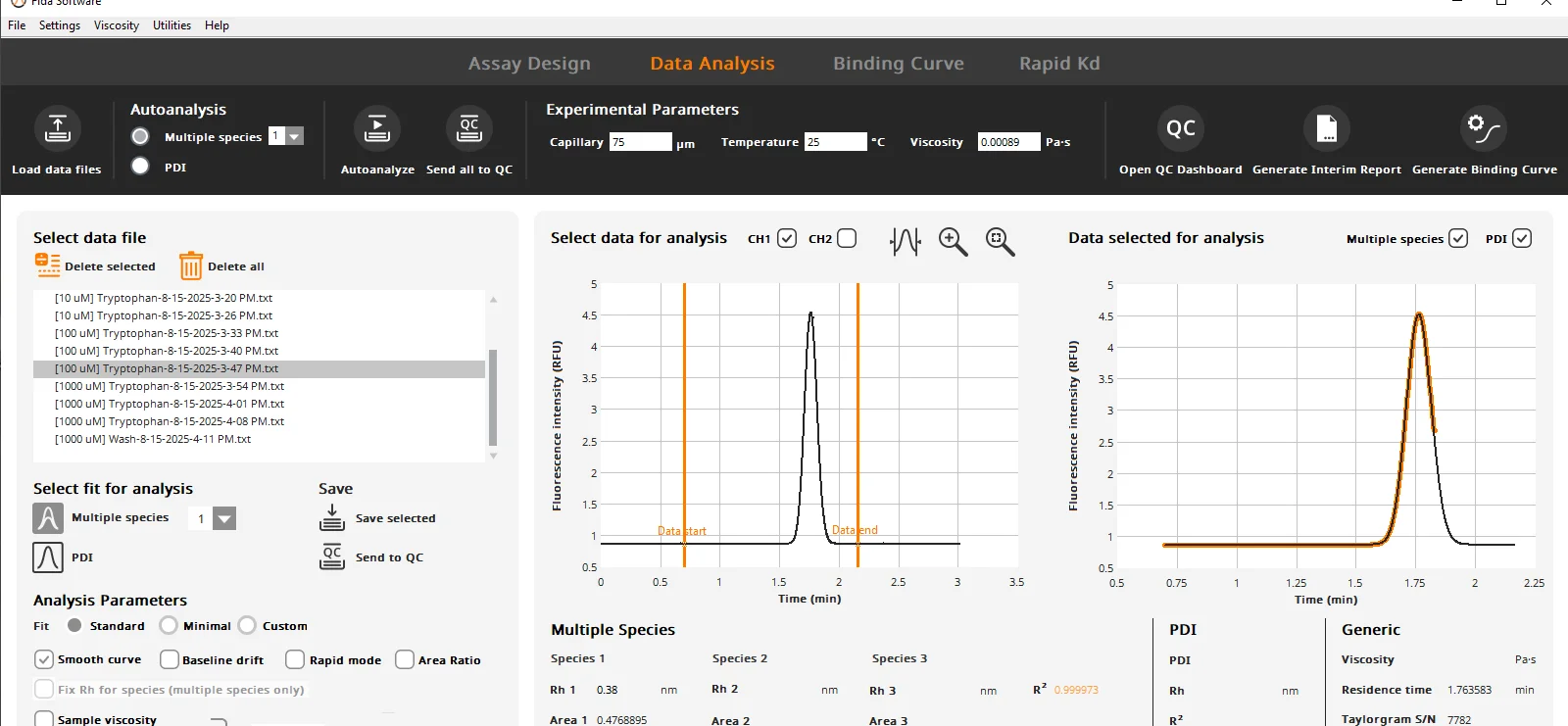
FIDA has no real lower size limit: sizes down to 0.3 nm in hydrodynamic radius have been measured. The lower limit is set mainly by how small the fluorophore can be and still give a signal. Tryptophan, which is used as the standard for detector quality control, measures about 0.38 nm (Figure 1).
At the other end, FIDA measures species of up to 500 nm in hydrodynamic radius. The smallest species include small biomolecules and peptides; the largest include large nanoparticles such as lipid nanoparticles (LNPs) and outer membrane vesicles (OMVs), liposomes, exosomes and virus-like particles.
What is the biggest molecule that can be measured with FIDA?
The largest species FIDA can measure are about 500 nm in hydrodynamic radius, or 1 µm in hydrodynamic diameter. These include exosomes, liposomes, virus-like particles (VLPs) and adeno-associated viruses (AAVs). For particles such as LNPs, AAVs and VLPs, the slim capillary is the one to use, as listed in the Hardware Basics course on the Fidabio Learning Hub; see Which capillary should you use, and how do you look after it?
Which sizes can you measure at the standard settings?
At the standard settings, 400 mbar and 25 °C, the hydrodynamic radius range is 0.5 to 13 nm, as explained in the Assay set up course on the Fidabio Learning Hub. A size of 13 nm corresponds to a globular protein of almost 2 MDa, much bigger than most protein complexes; the molecular weight to size calculator converts between the two.
The maximum run pressure for a molecule depends on its size, the capillary temperature and dimensions, and the sample viscosity. The experimental evaluation tool in the Fida software tests whether the run conditions meet Taylor's conditions for a given size; see What does FIDA Software include?
How precise is FIDA's hydrodynamic radius (Rh)?
For most systems FIDA reproducibly detects size changes of as little as 1%. However, the precision depends on the system studied. FIDA measures hydrodynamic radius with sub-Ångström accuracy, which opens up applications such as binding, conformational changes and unfolding.

Frequently asked questions
What is hydrodynamic radius?
The hydrodynamic radius is the size a molecule or particle appears to have when it moves through a liquid, including the water it drags along with it, as defined in the Molecular size course on the Fidabio Learning Hub. See What is hydrodynamic radius?
How does FIDA measure size?
FIDA records the fluorescence of a nanolitre sample plug as it flows through a capillary. Small, fast-diffusing molecules give a narrow, sharp peak; larger, slower-diffusing molecules give a wider peak. The peak width gives the diffusion coefficient through Taylor dispersion, and the Stokes-Einstein equation converts it into hydrodynamic radius, with the sample viscosity calculated for every measurement. See Stokes-Einstein equation: symbols and SI units.
Related resources
What is hydrodynamic radius? explains the readout, and Stokes-Einstein equation: symbols and SI units gives the equation behind it. The molecular weight to size calculator estimates hydrodynamic radius from molecular weight, and back. To find out whether FIDA can measure your molecules, book a discovery call.