Is it possible to work in PEG, glycerol or DMSO with FIDA?
Yes. Viscous media such as polyethylene glycol (PEG), glycerol and dimethyl sulfoxide (DMSO) can be measured with FIDA, provided the viscosity of the sample is accounted for in the size calculation. Because viscosity is measured and compensated at every measurement, a high percentage of viscous additive can be added to the buffer before a FIDA measurement. The rule is simple: you should always compensate for viscosity changes.
Do viscous additives need pre-calibration?
No. The Fida instrument gives complete flexibility with the use of buffer additives, and additives which may skew sample viscosity can be used without any pre-calibration. The viscosity comes from the sample's own run rather than from a value you supply.
How do you recognise a viscosity problem in your data?
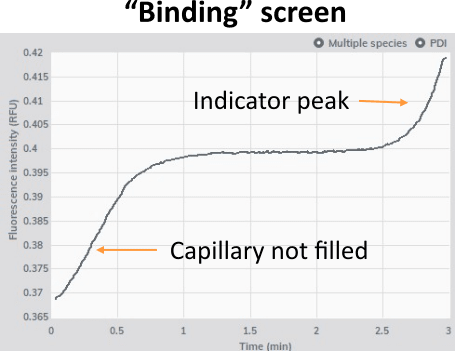
A viscosity effect is visible before the analysis stage, in the indicator and binding checks.
The indicator check passes normally. In the binding check, the two signs are an initial baseline that is not flat and an indicator peak arriving late. Together they indicate that the current method is not suitable for the viscosity of the sample.
The initial slope of the Taylorgram indicates that the capillary is not being properly filled. Increase the analyte fill step and the run time to compensate for that.
A change in the retention time of the indicator is itself the signal that viscosity compensation is needed.
What does viscosity compensation actually do?
Viscosity compensation is the automatic use of the correct viscosity in the Stokes-Einstein correlation, rather than an assumed viscosity of water.
To do that, the retention time of a sample with the viscosity of water has to be known. When you input that retention time and select viscosity compensation and sample viscosity, the real size of the molecule is analysed. Done correctly, the measured viscosity then also appears in the generic results alongside the size.
How do you compensate a binding curve?
In a normal titration the zero analyte point is often in PBS, so its residence time can serve as the reference. Selecting viscosity compensation in the binding curve tab tells the software to assume that the viscosity at the zero analyte concentration is that of water, and to apply that across the full data set.
If your buffer is not the viscosity of water, for instance because it contains glycerol, you define the retention time of a sample in an aqueous buffer instead. That only needs to be measured once, at the assay temperature, for each capillary.
How do you compensate a single sample in a viscous buffer?
For single samples where the buffer is not the viscosity of water, measure or look up the retention time of a standard molecule in an aqueous buffer. Enter that residence time and select the ticks for sample viscosity and sample, and the viscosity compensated size is displayed along with the sample viscosity.
The worked example in the source uses fluorescein in PBS as the standard for the 480 nm detector, with the sample being fluorescein measured in PBS plus 10 per cent glycerol. Run the same analysis with viscosity compensation deselected and the size comes out artificially high.
Which standard should you use for each detector?
For the 280 nm detector, 1 g/L bovine serum albumin (BSA) in PBS. For the 480 nm detector, 100 nM fluorescein in PBS. For the 640 nm detector, 100 nM Cy5 in PBS.
Where no zero analyte point is available at all, the average retention time of 1.8 minutes at 25 degrees Celsius can be used as the reference.
Frequently asked questions
Is it possible to work in viscous media (PEG, glycerol or DMSO) with FIDA?
Yes. Viscosity is measured and compensated at every measurement, so a high percentage of viscous additive such as glycerol, DMSO or PEG can be added to your buffer before a FIDA measurement.
What happens if you do not compensate?
The size comes out artificially high. In a concentration series the error is not uniform: measured size grows steeply towards the top of the series, because viscosity rises with concentration and the effect is exponential rather than linear. Uncompensated data does not look obviously wrong, which is why it can be mistaken for real association or aggregation at high concentration.
Related resources
The application note Robust Viscosity Measurement: Advancing Biologic Formulation with FIDA Technology covers viscous formulation work directly. The poster Characterising Lipid Nanoparticles with FIDA shows viscosity measured alongside sizing, PDI and aggregation in a single run.
On this site: What is sample viscosity? and the Sample Viscosity readout.