What is FIDA?
FIDA stands for Flow Induced Dispersion Analysis. It is a first-principles, in-solution method that characterises molecules by measuring how they disperse as they flow through a narrow capillary. From a single measurement it returns a molecule's size in solution (its hydrodynamic radius) and, from that size, information on binding affinity, aggregation, oligomeric state, stoichiometry and sample quality. Nothing is immobilised, sample volumes are tiny, and it works even in crude or patient-derived matrices.
What is Flow Induced Dispersion Analysis?
Flow Induced Dispersion Analysis is a precise, quantitative and highly robust biophysical method to determine how a change to a molecule affects that molecule. The change can be almost anything: adding a binding partner, or altering the environment through ionic strength, pH, buffer, temperature or a different crude matrix. The main readout is the hydrodynamic radius, and from it FIDA reports quantity, binding affinity, sample integrity, changes in oligomeric state, aggregation and stoichiometry. Because it rests on physics rather than a reference standard, it gives an absolute measurement.
How does FIDA work?
FIDA rests on two established physical principles: Taylor dispersion of molecules in laminar flow through a capillary, which gives their diffusion coefficient, and the Stokes-Einstein equation, which converts that diffusion coefficient into the hydrodynamic radius. The Fida instrument measures the fluorescence of particles carried in that laminar flow and analyses how they disperse over time. Analysing that signal gives an accurate value for the molecule's diffusivity, and therefore its hydrodynamic radius. When a binder is measured in the presence of its ligand, the change in apparent hydrodynamic radius reflects the strength of the interaction.
Inside the capillary the sample starts as a narrow plug at the inlet. As it flows, diffusion spreads it into a parabolic profile, and the shape of that profile is governed by the sample's diffusivity, which is set by its hydrodynamic radius. The fluorescence signal records the peak, and the peak shape is what reports molecular size.
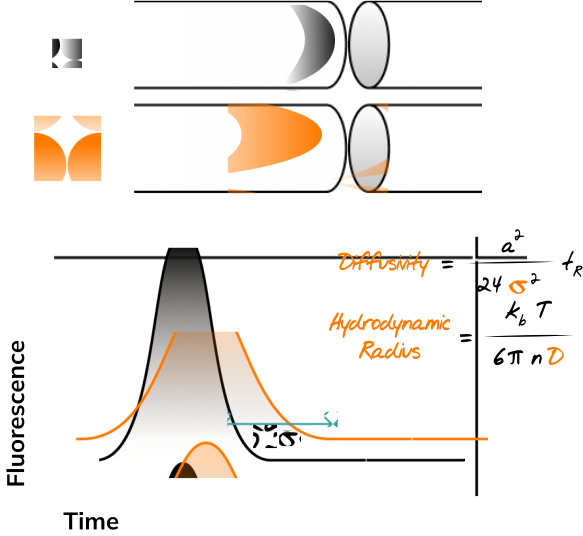
Small molecules diffuse quickly and produce sharp, narrow peaks; larger molecules diffuse slowly and produce broader peaks. To see it in practice: an amino acid such as glycine is tiny and moves very fast, giving the sharpest peak; a peptide such as insulin is slower, giving a moderate peak width; and a large folded protein such as haemoglobin moves the slowest, giving the broadest peak. Thanks to the fluorescence-based diffusivity measurement, some simple maths then gives you the hydrodynamic radius, and it is all done in the software, so we will not dive into the detail here. If you want it, you can access our e-learning platform.
And what does this measurement give you? Once you can measure the hydrodynamic radius you can run many assays: binding and interaction studies, aggregation, oligomerisation, conformational changes and sample purity tests. For example, you can build a binding curve by titrating with a ligand and watching the change in hydrodynamic radius. That breadth is why FIDA is used across the life sciences, the food industry and even mining.
What readouts does FIDA give?
FIDA measures three things directly: molecular size, binding affinity and binding kinetics. Those three measurements produce eleven readouts from a single run, because the same signal that reports size also reports the state and quality of the sample. Nothing has to be measured separately beforehand.
Molecular size is the absolute hydrodynamic radius in nanometres. Binding affinity is the dissociation constant KD, taken from the change in size as the molecule is titrated with its partner. Binding kinetics gives the association rate kon and the dissociation rate koff: reaction time is set by in-capillary mixing and pressure, so the system can be read before it reaches equilibrium, and the gap between the equilibrium and out-of-equilibrium curves yields the rates. One set of experiments therefore returns KD, kon and koff.
Sample state comes from the same run. Aggregation is counted from the raw signal. Polydispersity index reports how heterogeneous the sample is by size distribution. Stickiness shows as tailing on the peak when sample adsorbs to the capillary wall. Sample viscosity is measured on every run rather than supplied from a separate viscometer. Sample loss accounts for material that does not arrive at the detector. Labelling quality separates free from conjugated fluorophore. Quantification gives the amount of material present. Finally, the PDB correlator predicts the radius expected from an experimental structure or an AlphaFold model, so the measured value can be checked against a structural one.
All eleven are described on the readouts overview. The application note Assessment of Sample Quality with Every Measurement shows them read from a single sample.
What does it mean that FIDA is a first-principles technology?
FIDA is based on two first principles: Taylor dispersion and the Stokes-Einstein equation. In physics, work is based on first principles when it starts directly at the level of established science and does not rely on empirical modelling or parameter fitting; on the theoretical side, FIDA rests on the descriptions of Geoffrey Taylor and Albert Einstein.
Taylor Dispersion Analysis (TDA) works because flow through a capillary is laminar: the velocity profile is parabolic, so molecules in the centre move faster than those near the wall, while radial diffusion moves them across these streamlines. Small molecules diffuse across quickly and large ones slowly, and the balance between flow and diffusion spreads the sample plug in a predictable way. From that spreading FIDA obtains the diffusion coefficient, and the Stokes-Einstein equation turns it into the hydrodynamic radius.
Calling FIDA a first-principles technology means three things. It relies on the basic laws of nature, it is absolute rather than relative, and it does not require calibration. There is no reference curve to build and no standard to run first: the measurement comes straight from the physics of diffusion and flow.
Why measure in solution, and what are FIDA's advantages?
FIDA measures molecules free in solution, with nothing attached to a surface, which avoids the artefacts that immobilisation can introduce and keeps the molecule in a near-native state. Each data point uses nanolitre-to-microlitre volumes, so little material is needed, and the method tolerates complex backgrounds such as serum, plasma and lysate. Because size, binding, aggregation and sample quality all come from the same measurement, one run answers several questions at once.
In solution, both binding partners diffuse freely and meet by Brownian motion, so FIDA observes reversible interactions, binding equilibria and conformational changes as they happen. With no sensor surface there is no diffusion boundary layer and no local depletion of analyte, so mass transport does not limit the measurement, and there is no surface to regenerate between cycles. How this plays out for rate constants is covered in Can FIDA measure kinetics?
What can FIDA be used for?
Binding and molecular interactions. Affinity is measured in solution for protein-protein interactions, protein-small molecule binding, protein-nucleic acid binding, antibody-antigen binding, peptide-protein interactions and membrane protein-ligand binding. Since nothing is immobilised and no purification is needed, complexes can also be measured in crowded or native environments, including biofluids such as plasma.
Oligomerisation and self-association. A radius larger than a globular protein of the same mass points to an elongated structure, disordered regions or oligomerisation; one larger than the fully unfolded monomer points to higher-order oligomers. The technical note The relationship between hydrodynamic radius and molecular weight sets out the three zones and where the correlation breaks down.
Conformational changes. Folded proteins are compact and give a smaller radius; unfolded or denatured proteins expand and give a larger one, so a change in conformation registers directly as a change in size. That makes the measurement useful for stability work, thermal unfolding and misfolding diseases. Where a change is too subtle to move the size, Lambda Dynamics and BRIC pick it up instead.
Aggregation, stability and solubility. Aggregation is quantified on every run, so buffer, pH and salt conditions can be screened for those that keep a protein soluble and monomeric, and storage or freeze-thaw effects can be followed. This runs from amyloid fibril research through to bioprocessing quality control.
Liquid-liquid phase separation. Each condensate is counted and its relative size measured, which gives a quantitative readout of phase separation. Taylor Dispersion Induced Phase Separation screens for LLPS label-free using nanolitres of both compound and biomolecule, and can generate phase diagrams and dose-response curves. See biomolecular condensates.
De novo protein design. Designed binders are screened and characterised directly in lysate, without purification, so binding screening, KD and aggregation all come from unpurified material on one platform. See de novo proteins.
CRISPR. Cas-gRNA interactions are detected across both weak and strong binding, with quantitative KD and Rh, which supports guide RNA screening and characterisation of the editing components. See CRISPR.
Targeted protein degradation. The ternary complex is characterised quantitatively, with the KD of each binding partner and the cooperativity factor, and validated by directly measuring the change in size. A degrader's capacity to induce degradation is assessed from minute changes in the size of the target protein, selectivity by whether a candidate moves the size of proteins other than the intended one, and the ubiquitination reaction can be followed in real time in 15 to 30 minutes. See targeted protein degradation.
Protein expression. Expression level, affinity and protein integrity are assessed at once, in purified and non-purified samples. See protein expression.
Engineered antibodies. Antibody-antigen binding, aggregation and sample integrity are measured together, which matters where a candidate has to be judged on more than affinity. See engineered antibodies.
Structural biology. Samples bound for cryo-EM, crystallography or NMR are screened before the expensive step: key properties in about four minutes from a few hundred nanolitres, radius from 0.5 to 500 nm with globular size changes resolved to 5 per cent, aggregates returned as a count, and polydispersity showing whether the sample is homogeneous. See structural biology.
Nanoparticles. Lipid nanoparticles, AAVs, exosomes and virus-like particles are characterised for size, polydispersity and binding. See lipid nanoparticles.
Frequently asked questions
What does FIDA stand for?
Flow Induced Dispersion Analysis. It measures how a molecule disperses in a flowing capillary to determine its size in solution.
What is the main physical phenomenon FIDA measures?
Diffusion. As the sample travels down the capillary its molecules spread sideways across the flow, and how fast they spread is what the measurement comes down to. Because the measurement is made in free solution, with nothing immobilised and no purification required, the result describes the molecule under the conditions of interest, including in a crude matrix such as lysate, serum or plasma.
Does FIDA need calibration?
No. FIDA is a first-principles, absolute method: the hydrodynamic radius is derived from the physics of diffusion and laminar flow, so there is no calibration curve or reference standard to run.
Does FIDA need immobilisation or labelling?
FIDA is an in-solution method and the molecule is measured in its native state. Detection is fluorescence-based, and label-free measurement is possible using native protein fluorescence.
Can FIDA measure binding when the molecules do not change size?
Yes. Small molecule binding often produces no meaningful size change. Lambda Dynamics picks up the change in the ratio of fluorescence at two wavelength regions, and BRIC captures changes in fluorescence intensity.
How is FIDA different from surface-based methods?
The measurement happens in solution, with nothing attached to a chip or sensor surface, and it tolerates crude matrices. Sample quality parameters are reported alongside the result rather than hidden by the format.
What does FIDA actually measure?
Directly, it measures the hydrodynamic radius, a molecule's size in solution. From that size it derives eleven readouts, including binding affinity, kinetics, aggregation, oligomeric state, polydispersity, stickiness, viscosity and sample quality.
What kinds of samples can FIDA handle?
Anything from a small amino acid to a large protein complex, in ordinary buffers and in crude matrices such as serum, plasma or lysate, using very small sample volumes.
What types of protein analysis assays can be done with FIDA?
FIDA runs binding affinity assays, protein interaction studies, protein quantification and detection, protein expression checks, quality control assays and immunoassays, all from the same in-solution measurement of size. Worked examples of each are in the application notes.
Can FIDA measure the effect of protein regulation?
Yes, in two ways. If a regulatory change alters the size of the protein, FIDA measures it directly as a change in hydrodynamic radius. If the change is meant to alter affinity for a target, FIDA measures the KD before and after, so you can see whether binding actually got stronger.
Related resources
For the full method and the instrument, see the FIDA technology page and the readouts overview. The handbook Biophysical characterisation for hit identification and validation: the role of FIDA shows where it fits in a discovery workflow, and the Fida technology brochure covers the instrument range.
For measuring in solution under native conditions, the application note Protein Oligomerization: Easy and Accurate determination in plasma and buffer compares the same protein in buffer and in plasma, the publication In-solution Characterization of Biomolecular Interaction Kinetics under Native Conditions applies it to rate constants, and Flow Induced Dispersion Analysis Rapidly Quantifies Proteins in Human Plasma Samples shows quantification directly in a biofluid. The equation behind the size measurement is set out in Stokes-Einstein equation: symbols and SI units.
On the blog, What is laminar flow and how does it relate to Taylor dispersion and the Stokes-Einstein equation? walks through the first principles step by step, How to overcome the limitations of surface-based kinetic assessments sets in-solution measurement against surface-based methods, and Measuring up: how hydrodynamic radius is revolutionising biophysical research explains the core readout, with video.
To find out whether FIDA fits your molecules and questions, book a discovery call.